Floor Scrubber Sizing Guide: How to Match Machine Size to Your Space
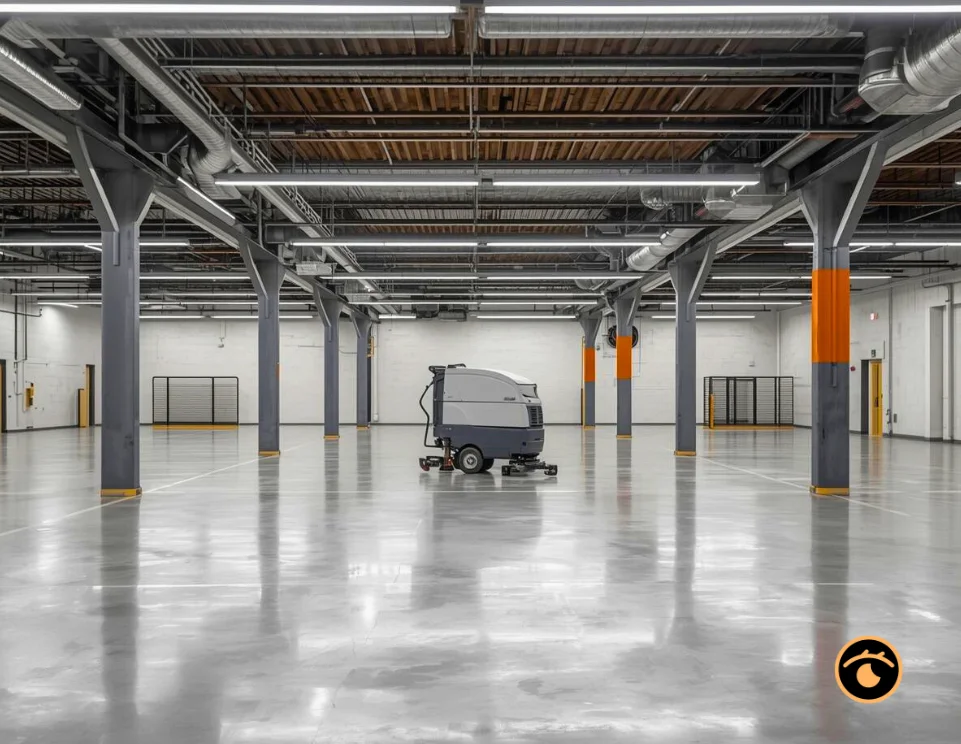

Why Size Is the Most Misunderstood Decision
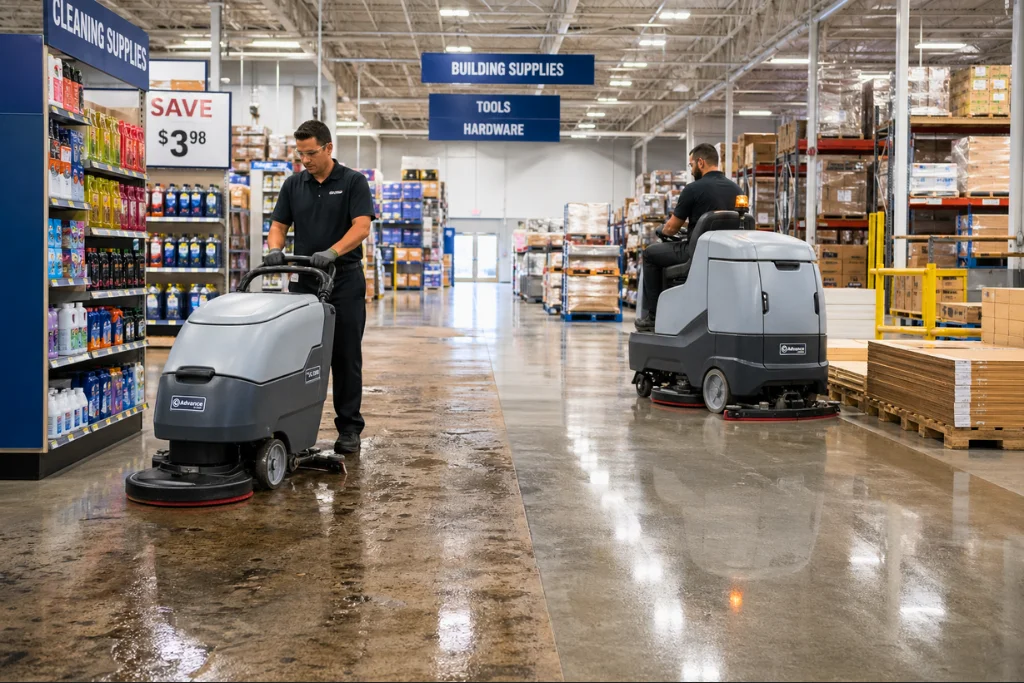
Choosing the wrong floor scrubber size is one of the most common — and most expensive — mistakes facilities make. It usually happens because size gets treated as a performance upgrade instead of a fit decision. After spending time watching how commercial cleaning equipment actually performs on real floors, I can tell you the size on the spec sheet rarely tells the whole story.
Bigger is assumed to mean faster and more thorough. In practice, an oversized scrubber often does the opposite: it slows cleaning down, tires operators out, and quietly produces inconsistent results day after day. Go too small, and you're stuck making extra passes — more time, more effort, and a job that never quite feels finished.
This guide exists to help you match machine size to how your space is actually cleaned, not how it looks on a floor plan. We're focused on layout behavior, workflow, and daily use here — not spec sheets or marketing claims.
Already know whether a walk-behind or ride-on scrubber fits your facility? Good — this guide picks up from there and helps you dial in the right size within that type.
Quick Size Guidance (At a Glance)
- Tight layouts / frequent turns: Small, compact scrubbers
- Mixed layouts: Mid-size walk-behind scrubbers
- Large open floors: Larger walk-behind or ride-on scrubbers
- Multiple zones: Size for the most restrictive area, not total space
If a machine struggles in your tightest zone, it will struggle every day.
In this guide:
- Why Square Footage Alone Causes Bad Decisions
- Understanding Cleaning Zones Inside a Facility
- Practical Size Categories
- Layout Factors That Change Size Decisions
- Cleaning Frequency and Time Window
- Staffing, Training, and Operator Impact
- Common Sizing Mistakes to Avoid
- A Simple Size Selection Checklist
- When You Should Delay Buying
- Final Note
Understanding Cleaning Zones Inside a Facility

Diagram showing primary, secondary, and tight cleaning zones inside a facility for floor scrubber size planning
Most facilities aren't cleaned as one continuous space. In practice, they're cleaned zone by zone, and each zone has its own layout and movement demands.
Common cleaning zones include:
- Primary open areas — lobbies, warehouses, large retail floors
- Secondary areas — aisles, corridors, workspaces
- Tight zones — entrances, corners, restrooms, transitions
A machine that performs well in one zone can be inefficient in another. Larger machines cover open areas quickly but bog down in confined spaces. Smaller machines handle tight zones with ease but take longer to clear open floor.
Knowing where most of your cleaning time is actually spent matters more than knowing the total facility size — this is the same layout-first thinking behind our broader guide to commercial floor scrubber machines, where daily workflow carries more weight than raw specifications.
Many facilities burn more time in secondary and tight zones than expected, even when open areas dominate the floor plan on paper. Size decisions should follow the most restrictive zones, not the most impressive ones.
Practical Size Categories (Decision Rules, Not Specs)
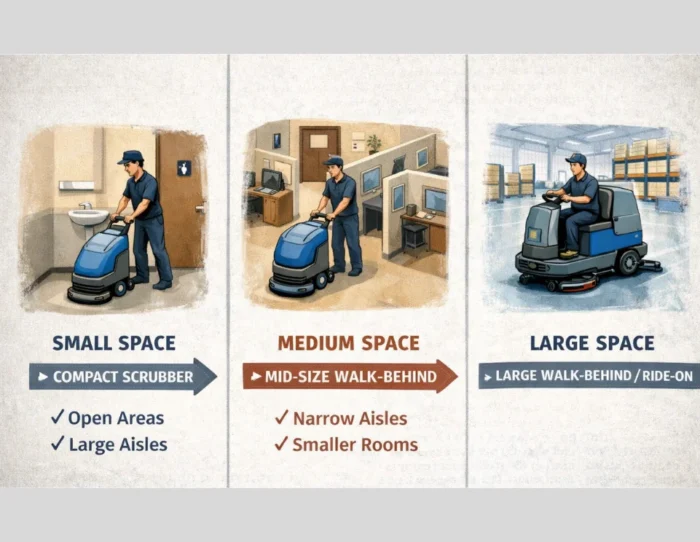
Floor scrubber size categories matched to small, medium, and large facility layouts
Rather than starting from technical measurements, it helps to think in practical size categories built around how machines actually behave in real environments.
4.1 Small Spaces (Compact & Tight Layouts)
Compact machines are the right call for:
- Offices with furniture and partitions
- Small retail spaces
- Clinics and classrooms
In these environments, maneuverability beats width every time. An oversized machine here becomes frustrating fast — and frustrating equipment tends to get avoided rather than used.
4.2 Medium Spaces (Mixed Layouts)
Mixed-layout facilities include:
- Grocery stores
- Schools
- Medium-sized commercial buildings
These spaces demand balance. A machine has to cover open areas efficiently while still handling aisles and transitions without a fight. Mid-size machines struggle the moment they lean too far toward raw coverage or too far toward tight control.
4.3 Large Spaces (Open & Repetitive Layouts)
Large, open environments reward machines that:
- Maintain steady, uninterrupted movement
- Minimize operator fatigue
- Reduce repeated passes
Here, bigger genuinely works better, because layout complexity is low and there's little maneuvering to slow things down.
4.4 Very Large Facilities
In very large facilities, efficiency stops being about the machine and starts being about the plan around it:
- Cleaning route design
- Storage and charging access
- Operator rotation
Maximum size alone won't deliver better results without workflow planning behind it.
Layout Factors That Change Size Decisions
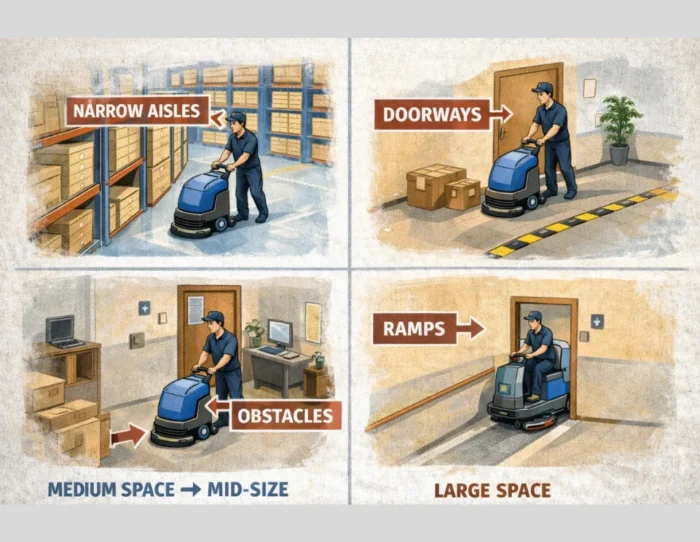
Common layout constraints such as narrow aisles, obstacles, and doorways that affect floor scrubber size selection
Layout details often force size adjustments that square footage and general categories simply can't capture. These are the factors that determine whether a machine moves smoothly or fights the space all day.
Aisle width and turning frequency. Narrow aisles and frequent turns favor smaller, more controllable machines. A larger scrubber loses ground every single time it has to slow down, reposition, or reverse.
Obstacle density. Shelving, furniture, displays, and equipment all raise the need for precise control. In an obstacle-dense layout, an oversized machine adds cleaning time — it doesn't cut it.
Doorways, ramps, and transitions. Moving between rooms, levels, or surfaces usually calls for tighter control and better visibility. Machines that struggle with transitions get skipped for those areas, which is exactly how inconsistent cleaning starts.
Storage and access paths. A machine still has to reach the cleaning area. If transport paths are narrow or storage is tight, a large machine can become impractical no matter how well it cleans.
These factors often outweigh theoretical efficiency. A machine that actually fits the layout gets used consistently, with fewer daily compromises.
Cleaning Frequency and Time Window
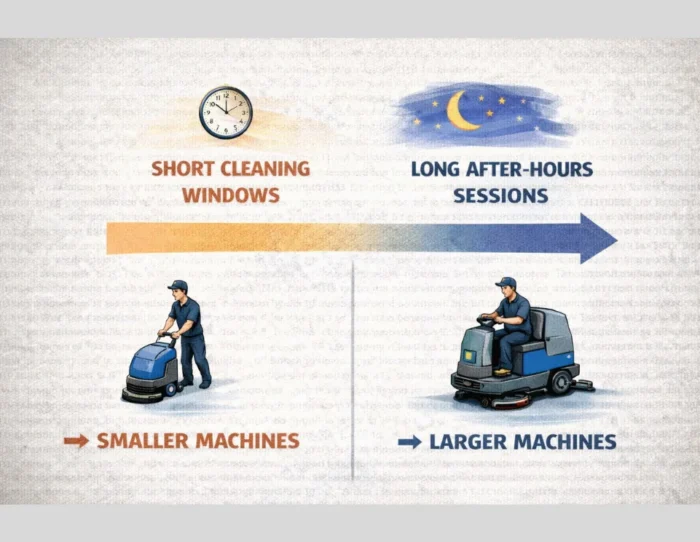
Diagram showing how cleaning time windows influence optimal floor scrubber size selection
How often — and when — you clean directly shapes the right machine size.
Facilities cleaning daily or multiple times a day do better with machines that start quickly, stop easily, and adapt as conditions change. Oversized machines slow down frequent cleaning simply because setup and handling take more effort each time.
Facilities that clean less often but for longer stretches can lean toward larger machines, especially when cleaning happens after hours along uninterrupted routes.
Time-window considerations include:
- Cleaning during business hours versus overnight
- Short cleaning windows versus extended sessions
- Pressure to reopen areas quickly and safely
Machines that match the cleaning schedule take pressure off staff and hold up better over time.
Staffing, Training, and Operator Impact
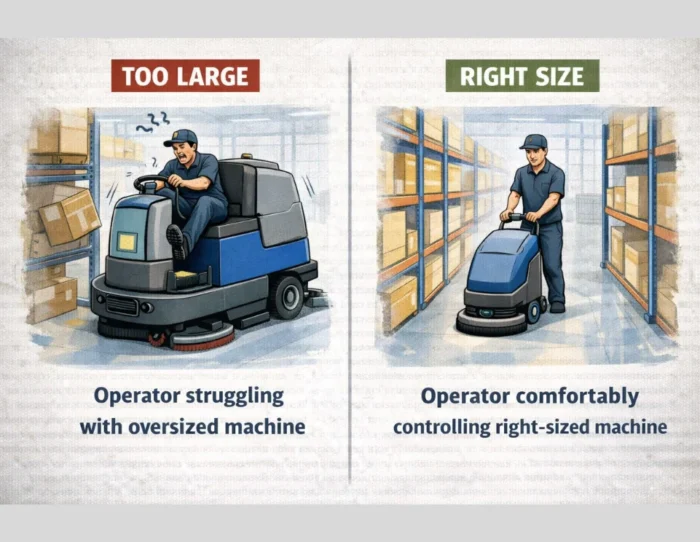
Operator comfort comparison showing how correct floor scrubber size improves control, safety, and consistency
Machine size affects more than cleaning speed. It shapes who can actually use the equipment, and how consistently they do.
Larger machines demand more training, more confidence, and more spatial awareness. New or rotating staff can feel genuinely uneasy operating oversized equipment in an active facility — and when a machine feels hard to handle, operators rush, avoid certain areas, or skip cleaning altogether.
Smaller, well-matched machines are easier to learn and far less intimidating. That tends to show up as:
- Faster onboarding for new staff
- More consistent cleaning quality
- Fewer mistakes around obstacles and people
Operator comfort also compounds over time. A machine that causes fatigue or frustration won't be used correctly for long, no matter how efficient it looks on paper.
Matching size to staff capability improves reliability far more than chasing the largest machine the budget allows.
A Simple Size Selection Checklist
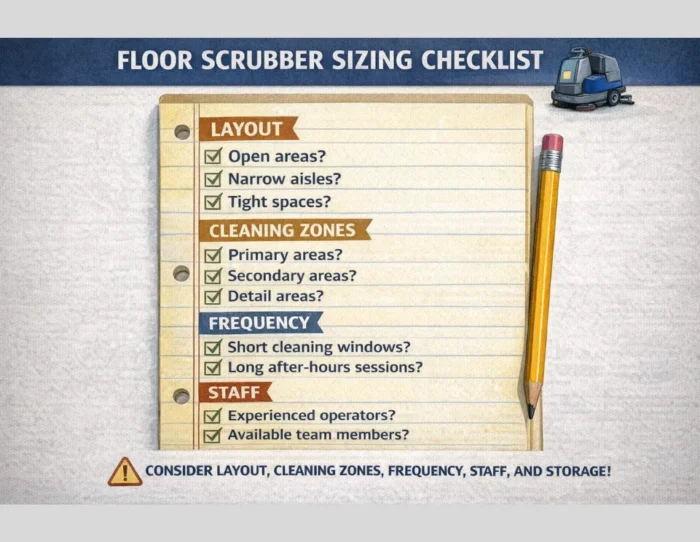
Floor scrubber sizing checklist covering layout, cleaning zones, frequency, staff, and storage considerations
Use this checklist to sanity-check your sizing decision before you start comparing machines.
- Layout type: open, mixed, or tight
- Primary cleaning zones: where most time is actually spent
- Cleaning frequency: daily maintenance or periodic deep cleaning
- Time window: during business hours or after hours
- Staff experience: stable team or frequent turnover
- Storage and access: where the machine lives and how it moves
If a machine struggles with any one of these, it will struggle in daily use — regardless of what the performance claims say.
The best size is the one that fits your most restrictive conditions, not your best-case scenario.
Final Note on Floor Scrubber Sizing
This sizing guide supports the broader decisions that go into floor scrubber selection by grounding those choices in real-world layout, staffing, and workflow behavior — not spec sheets.
Paired with a machine-type comparison and individual product reviews, it should help you avoid costly sizing mistakes and land on equipment that actually fits how your space gets used, not just how it looks on paper.
Why Square Footage Alone Causes Bad Decisions
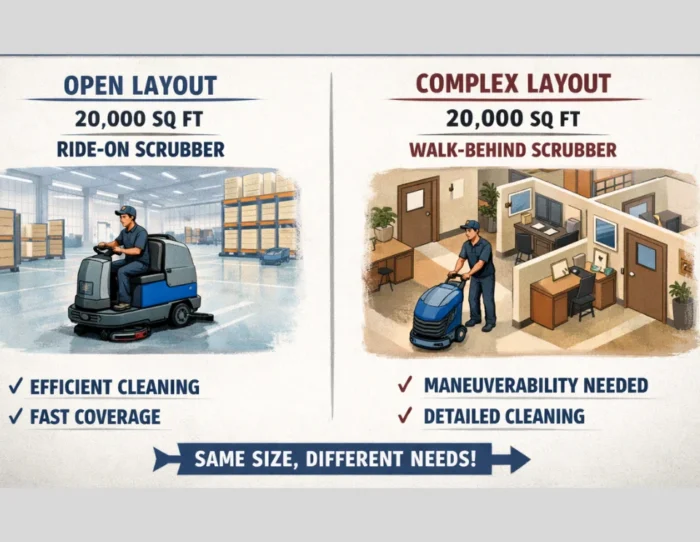
Two facilities with the same square footage but different layouts, showing why layout matters more than total size when choosing a floor scrubber
Square footage is usually the first number buyers look at. It's also rarely the most useful one.
Two facilities can share identical square footage and still present completely different cleaning challenges. An open warehouse with wide lanes lets a machine move continuously with minimal turning. A similarly sized retail store — full of aisles, shelving, and displays — forces constant stopping, turning, and repositioning.
In real-world cleaning, movement efficiency matters more than total area. Time isn't lost during the straight-line runs. It's lost during turns, obstacles, and the transitions between zones.
Relying on square footage alone tends to produce:
- Oversized machines that struggle in tight layouts
- Undersized machines that need excessive passes
- Inefficient cleaning routes that quietly add labor hours
Effective sizing starts with understanding how a space flows — not how large it looks on paper.
Common Sizing Mistakes to Avoid
Most sizing mistakes follow a predictable pattern.
Buying the largest machine the budget allows. This usually ends in poor maneuverability, storage headaches, and a machine that sits unused more than it should.
Ignoring storage and charging space. A machine that doesn't fit where it's stored becomes a daily obstacle, not a cleaning tool.
Assuming one machine has to clean every zone. Most facilities have areas that call for different approaches. One machine rarely excels everywhere — and that's fine.
Overestimating layout simplicity. Spaces almost always look more open on paper than they behave in real use.
Catching these mistakes early prevents long-term inefficiency — and a lot of daily frustration.
When You Should Delay Buying
Sometimes the smartest move is waiting.
Consider delaying a floor scrubber purchase if:
- The facility layout is about to change
- Cleaning routines aren't yet consistent
- Staffing levels or experience are unstable
- Storage or charging space isn't finalized
Buying too early tends to lock you into the wrong size. Waiting until your workflow and layout settle down prevents regret — and an unnecessary expense.
Engr. Hm Jamal
Founder & Lead Technical EditorFounder of Wits Engineer, with a practical background in electrical and water systems. His product reviews focus on setup, performance, maintenance and the trade-offs that affect everyday ownership.