CFM vs Water Lift vs Air Watts: Which Vacuum Power Actually Matters? (2026 Guide)
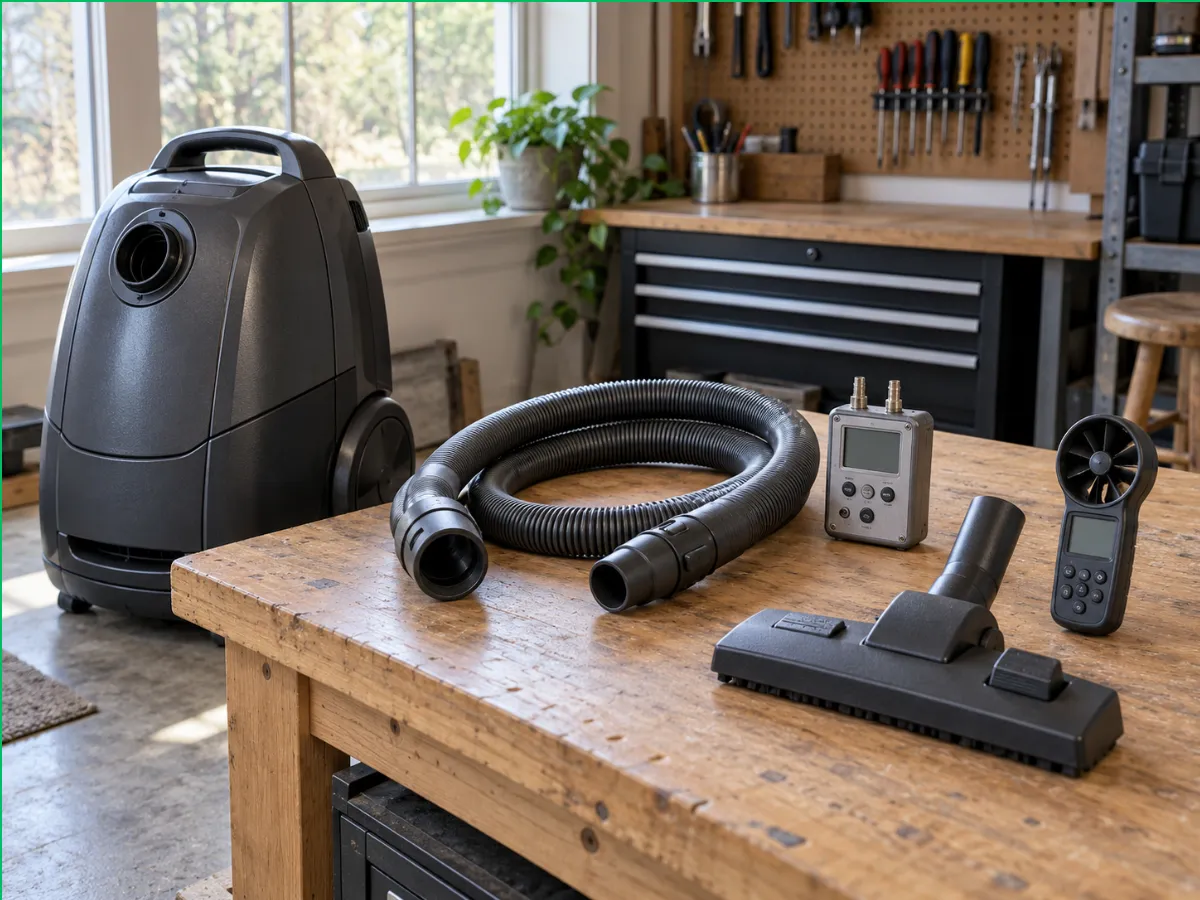

CFM measures airflow, water lift measures suction pressure, and air watts combine the two at the same operating point—the pressure and airflow present together during a particular test. Air watts are the most useful single air-power figure when test conditions match. Actual pickup results matter more when choosing a vacuum for your floors.
A cleaner still needs a suitable floorhead, effective agitation, a clear air path, and enough usable runtime. A high suction figure cannot compensate for a head that pushes cereal ahead of it or seals itself against a rug.
If you are comparing the best vacuum cleaners, use power specifications to understand the machine, then look for cleaning results on surfaces like yours.
When comparing CFM vs water lift vs air watts, keep one limitation in mind: maximum airflow and maximum sealed suction usually come from different test conditions. Multiplying those two headline figures does not produce a valid air-watt rating.
CFM vs Water Lift vs Air Watts at a Glance
| Measurement | What it measures | What it helps explain | What it cannot establish alone |
|---|---|---|---|
| CFM | Volume of air moved per minute | Air available to carry debris through the cleaning path | Carpet cleaning, pickup of bulky debris, or performance under restriction |
| Water lift | Suction pressure, expressed as an equivalent water-column height | Pressure capability; sealed lift describes the blocked-inlet endpoint | Airflow during cleaning or whether liquid pickup is permitted |
| Air watts, or AW | Air power calculated from airflow and pressure at the same operating point | Combined pneumatic output under stated conditions | Brush performance, dust retention, handling, or overall cleaning quality |
Use the units to identify what a manufacturer has measured before comparing the numbers. A pressure claim and an air-power claim cannot be ranked on the same numerical scale.
Pa, kPa, Watts, Amps, and Horsepower Explained
These units often appear beside CFM and air watts, but they do not all measure the same thing.
| Specification | What it tells you | Important limitation |
|---|---|---|
| Pa or kPa | Pressure difference; 1 kPa equals 1,000 Pa | Gives no airflow value by itself |
| Electrical watts | Electrical input power | Does not establish air output or pickup |
| Amps | Electric current | Current alone is not a measure of cleaning performance |
| Horsepower or peak horsepower | A motor-power claim whose meaning depends on the test | Peak output is not necessarily continuous operating output |
Water lift and pascals are convertible because both express pressure. One inch of water is approximately 249 Pa, so 80 inches is about 19.9 kPa. The precise conversion depends slightly on the water-column convention.
Neither conversion adds airflow information. You cannot convert Pa to CFM or air watts without additional measurements.
Also avoid treating horsepower as electrical input. Horsepower is a unit of power; a motor’s mechanical output and electrical consumption are different quantities. RIDGID, for instance, defines its peak-horsepower claim through laboratory motor testing with a dynamometer.
How to Compare Two Vacuum Spec Sheets
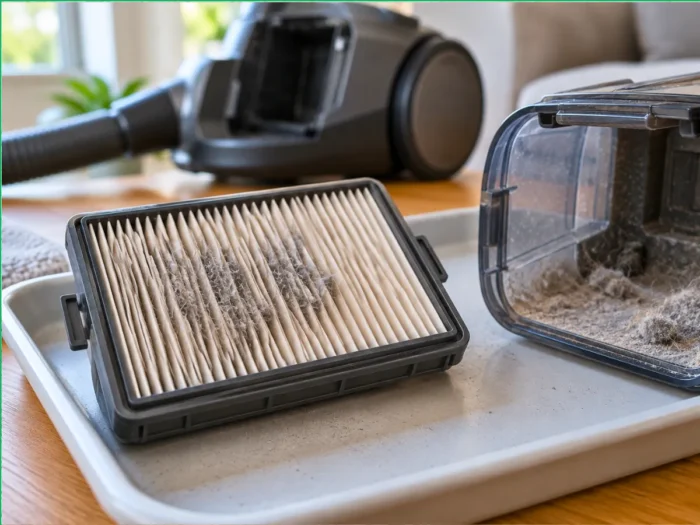 Filter condition can change working airflow as debris accumulates during use.
Before deciding that one machine is more powerful, check five things:
- Measurement location. Motor, machine inlet, hose end, and floorhead readings are not interchangeable.
- Installed equipment. Check whether the hose, bag, filter, and attachment were fitted, and whether measurements describe a clean or loaded collection system.
- Operating conditions. Check power mode, supply voltage or battery state, and useful runtime for cordless models.
- Test method. Look for an identified procedure and enough detail to understand the claim.
- Cleaning evidence. Confirm that results cover your floor, debris, and intended attachment.
If these details are missing, treat the figures as incomplete information. Do not turn them into a precise cross-brand ranking.
Also check performance after some use. A loaded filter, debris in the air path, or a collection container approaching its limit can change working airflow. The clean-machine specification does not describe every stage of a cleaning session; follow the maintenance instructions rather than removing required filtration to restore flow.
What Is CFM in a Vacuum Cleaner?
CFM means cubic feet per minute. It measures the volume of air passing through a measurement point over time.
Moving air helps carry loosened dirt from the cleaning head through the hose or ducting and into the collection system. But the measurement location matters. Airflow at a bare motor inlet is not automatically the airflow available through a fitted hose and floorhead.
A listing that says “120 CFM” leaves important questions unanswered: Was the hose attached? Were the filter and bag installed? Was the measurement taken at the motor, machine inlet, or end of the hose?
Some specifications use liters per second instead. 1 CFM is approximately 0.472 L/s, so 100 CFM is about 47.2 L/s. Converting the units makes the figures easier to read, but it does not make different test setups equivalent.
CFM is not air speed
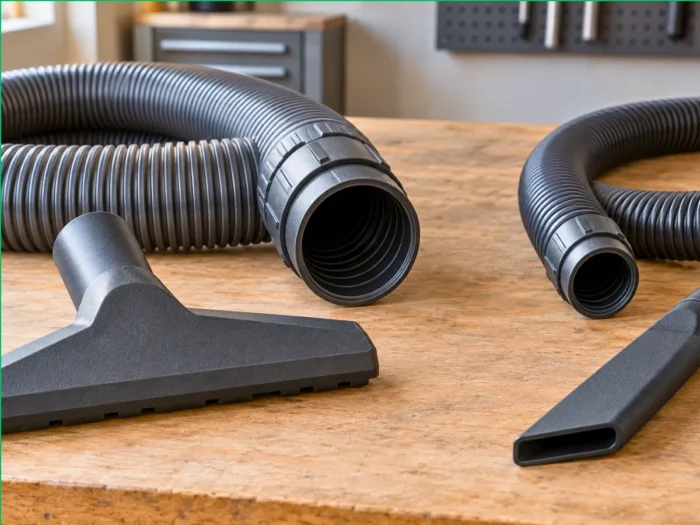 Hose diameter and attachment shape affect the air path; CFM measures volume flow, not air speed.
Airflow volume and air velocity are related, but they are different measurements. The same volume of air moving through a smaller opening has a higher average velocity than it does through a larger opening.
That helps explain why hose diameter matters. A wider hose can accommodate larger debris and reduce some flow losses, but its effect depends on the motor, hose length, tools, and actual operating airflow. “Wider always cleans better” is no more reliable than “higher CFM always wins.”
What Does Water Lift Mean?
Water lift expresses a pressure difference as the equivalent height of a water column, commonly in inches of water, written as in. H₂O.
For a conventional suction vacuum, the fan creates lower pressure inside the air path. Higher-pressure surrounding air then flows toward that lower-pressure region. Water lift describes that pressure difference. It is not a direct measure of the weight of debris the machine can pick up, and pressure should not be confused with force: force also depends on the area over which the pressure difference acts.
A figure described as sealed suction or sealed water lift usually represents the pressure reached with the test inlet closed. At that endpoint, useful flow through the inlet is essentially zero.
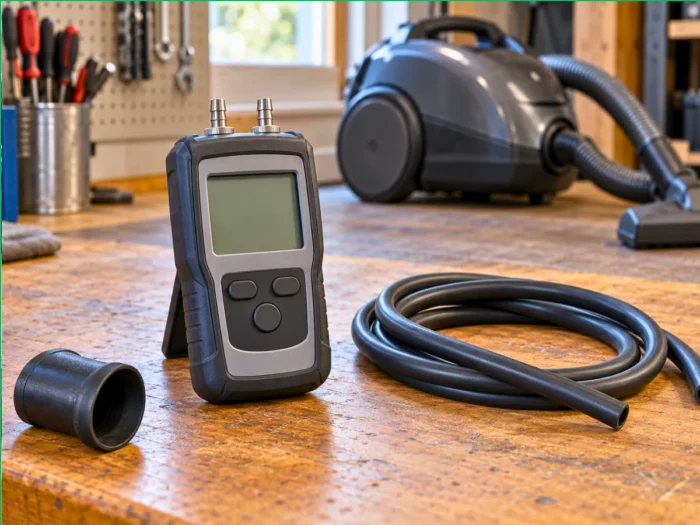 Water lift expresses pressure difference; it does not show airflow during cleaning.
During cleaning, the machine must move air against the resistance of its filter, hose, nozzle, and cleaning surface. A sealed test measures one endpoint of that system; it does not show how much air will flow through a carpet head or crevice tool.
Does higher water lift mean better liquid pickup?
Pressure capability matters when raising liquid, but the rating alone does not describe collection speed or the complete wet-pickup system. Hose geometry, air movement, tool design, tank arrangement, and shutoff mechanisms also matter.
Most importantly, a water-lift specification does not make a vacuum safe for water. Dry-only machines can have this rating too. Use liquid pickup only when the manufacturer permits it, with the required filter and tank setup.
What Are Air Watts?
Air watts measure pneumatic power: pressure difference multiplied by volumetric airflow at the same operating point. They describe output in the moving air, rather than the electrical power entering the appliance.
A commonly used approximate calculation is:
Air watts ≈ CFM × water lift in inches of water ÷ 8.5
In SI units, the basic pressure-flow relationship is:
Air power in watts = pressure difference in kPa × airflow in L/s
For example, a hypothetical reading of 60 CFM at 30 inches of water gives approximately 212 AW. A reading of 90 CFM at 20 inches also gives approximately 212 AW. These are calculation examples, not results from reviewed vacuums.
The examples show why equal air watts do not require identical airflow and pressure. They also reinforce the calculation rule: use values measured together, at the same operating point. Do not combine unrelated maximum ratings.
Air watts are not efficiency
A vacuum producing 200 AW is delivering 200 watts of air power under the stated test conditions. That number alone does not tell you how efficiently it uses electricity.
Efficiency requires comparing useful output with input power on an appropriate, consistent basis. Air watts alone are neither an efficiency percentage nor a percentage of dirt removed.
They also exclude useful work performed directly by an electrically driven brush motor. That matters when comparing a powered carpet head with a simple suction nozzle.
Why You Cannot Multiply Maximum CFM by Sealed Water Lift
As the opening in a vacuum test rig becomes more restrictive, airflow and pressure change. Near the open-flow end, airflow is high and the measured suction pressure is relatively low. At the sealed end, pressure is high but flow through the inlet falls to essentially zero.
Useful air power occurs between those extremes. Its peak depends on the motor’s pressure-flow curve and the connected system.
A specification sheet can therefore list three legitimate figures that do not fit together when you multiply the first two.
RIDGID’s HD0900 listing, for example, publishes 76 CFM, 70 inches of lift, and 231 air watts. Multiplying 76 by 70 and dividing by 8.5 gives roughly 626, not 231. That mismatch does not establish an error in the listing. The figures are not presented as one simultaneous operating-point measurement; RIDGID also identifies different bases for its airflow and air-watt specifications.
Do not calculate air watts from separately advertised maximum airflow and sealed suction. Ask for matched readings or a documented air-power rating instead.
Which Vacuum Power Metric Matters Most?
For comparing air systems under equivalent conditions, air watts are more informative than either airflow or sealed suction alone. For choosing a cleaner, relevant pickup results are more decisive.
ASTM F558 describes air-performance testing and explicitly cautions that its nozzle-on-plenum measurement does not represent actual air performance during carpet or floor cleaning. A standardized air test helps compare air systems. Separate pickup testing is needed to establish what happens on the floor.
Consider what an air-power number leaves out:
- Whether the nozzle admits larger crumbs or pushes them forward.
- Whether the brush loosens embedded carpet dirt.
- Whether hair wraps around the roller or passes into the collection system.
- Whether the head remains easy to move on your rug.
- How much dust escapes during operation or emptying.
The sensible buying order is surface compatibility, demonstrated pickup, ownership needs, and then comparable power specifications to help explain the result.
What Matters for Your Cleaning Job?
Carpet and embedded grit
Carpet cleaning depends on agitation, airflow through and around the pile, nozzle geometry, and suitable height or suction settings. A strong motor paired with the wrong head can be difficult to push without cleaning well.
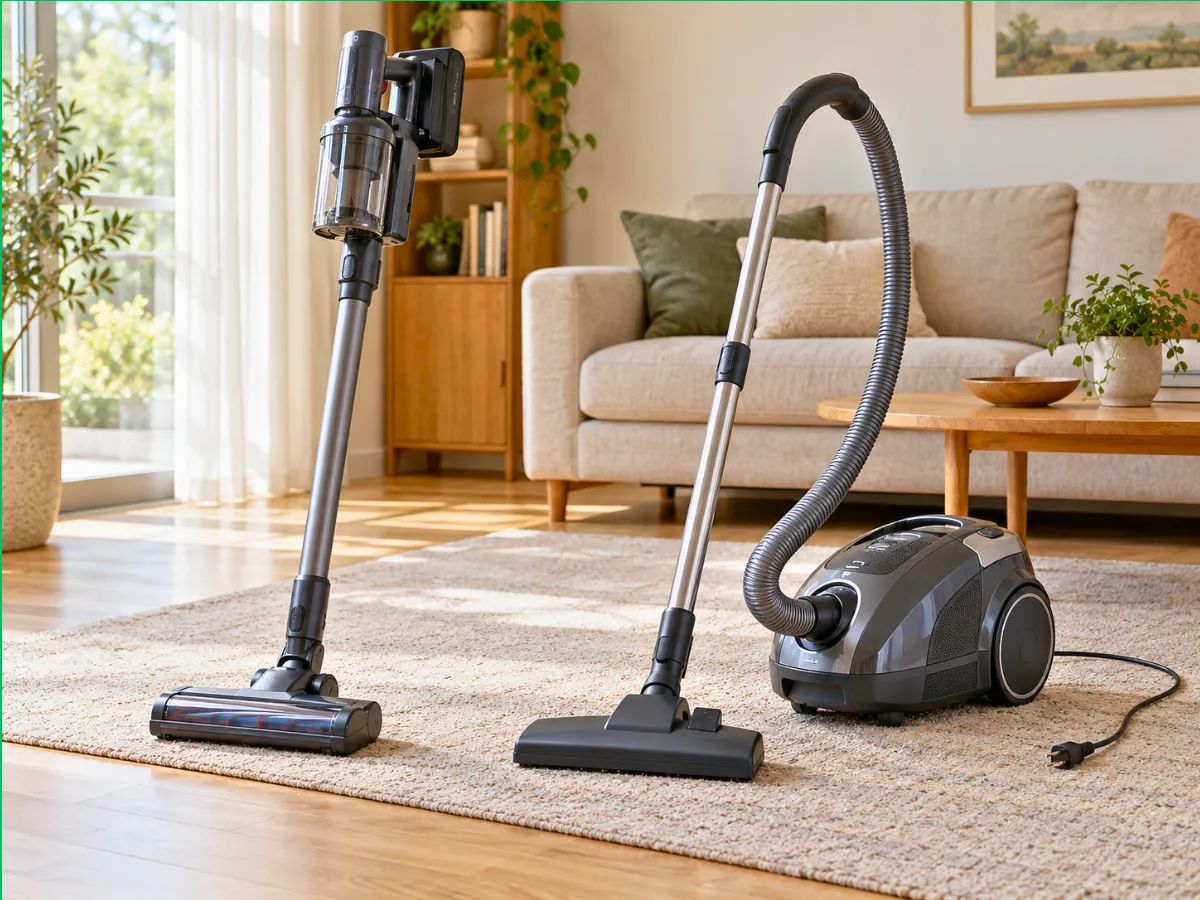
Brush type deserves attention. An air-driven turbo brush uses airflow to turn its roller; an electric powerhead has a separate brush drive. A simple suction nozzle has neither. Air watts alone cannot account for these differences in agitation.
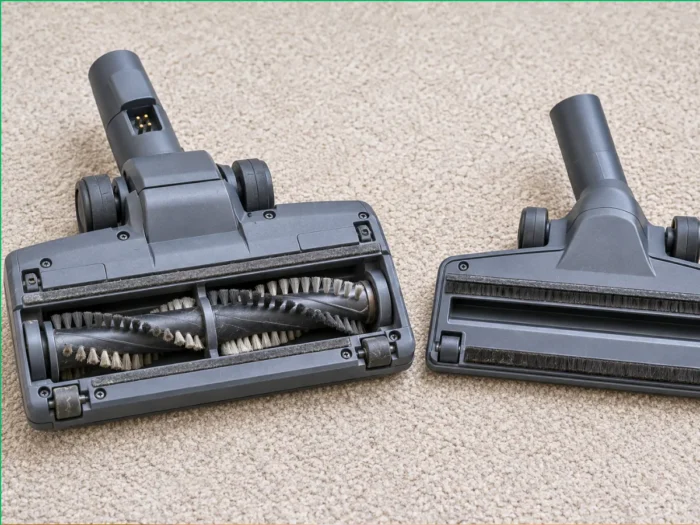 Brush agitation and nozzle design affect cleaning in ways an air-watt rating cannot describe.
Compare embedded-dirt results and handling in our best upright vacuum cleaners guide. If shedding is the main concern, use the best vacuums for pet hair guide to narrow the search around hair pickup and maintenance.
Hard floors and everyday cordless cleaning
On hard floors, the head must let debris enter, collect fine dust, and avoid scattering material. A sealed-suction number does not show how well it manages those tasks.
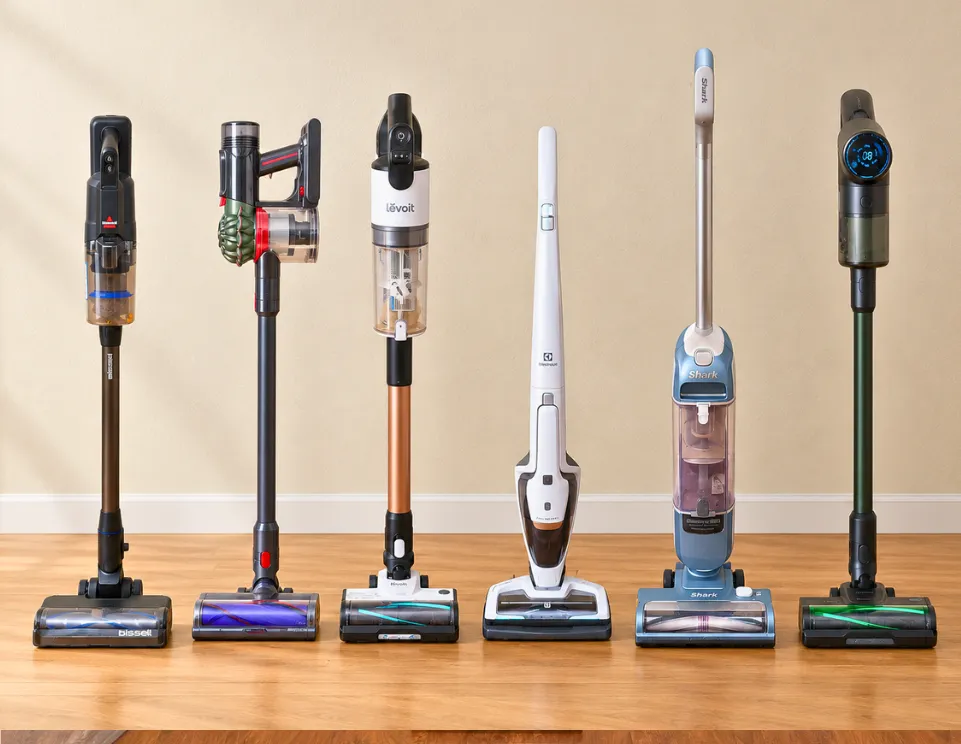
For cordless machines, check the power mode behind both the suction claim and the runtime claim. A maximum-output figure and an “up to” runtime may describe entirely different setups. Do not assume the vacuum delivers its maximum advertised AW for its longest advertised runtime. Check the mode, attachment, and battery conditions behind each claim, then look for runtime with the floorhead you will actually use.
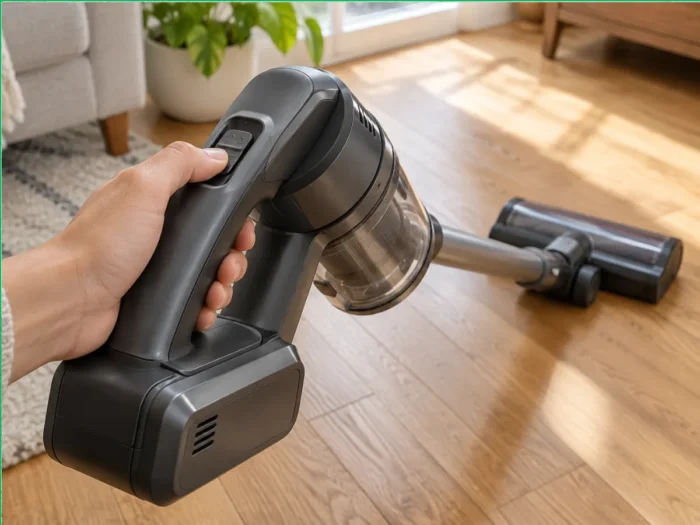 Compare suction and runtime claims using the stated mode, battery conditions, and attachment.
Our best cordless vacuum cleaners guide covers cordless options; the best stick vacuums guide is useful when you are comparing that format, including corded alternatives.
Cars, stairs, and upholstery
A crevice tool, narrow hose, and upholstery attachment change the resistance in the air path. Reach and tool fit can matter more than a small difference in advertised maximum power.
For a vehicle, consider access between seats and how the supplied tool works on mats. Compare the best car vacuum cleaners for that job, or the best handheld vacuums if you also need a compact cleaner for stairs and furniture.
Garages and workshop debris
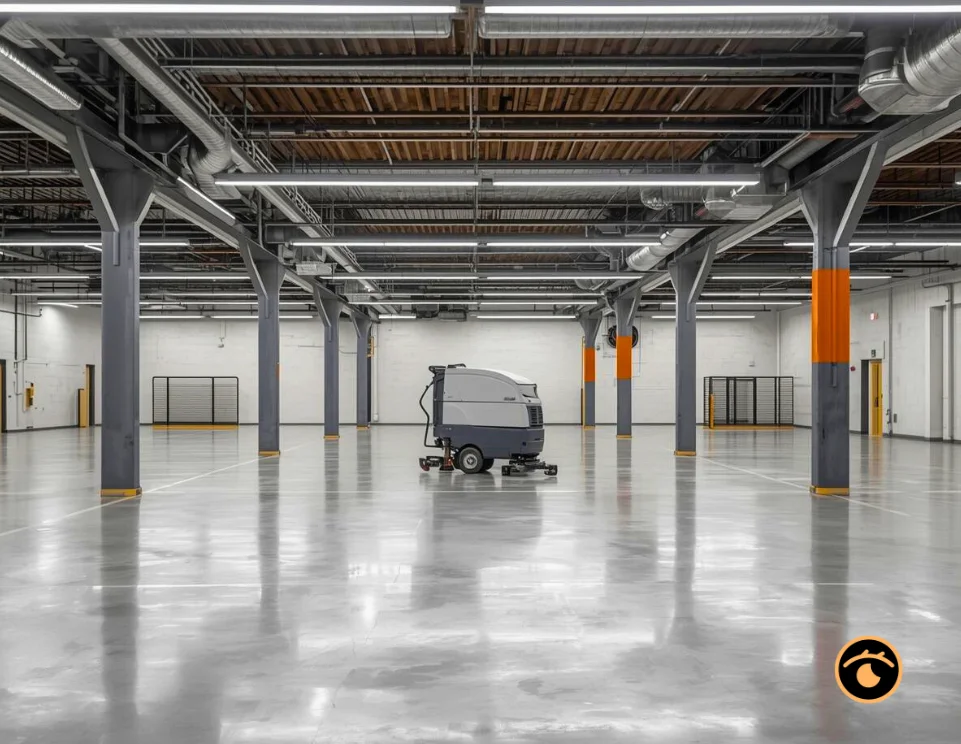
A shop vacuum needs to carry debris through its hose while working against the resistance of its tools and filtration. Look at working airflow, pressure capability, hose diameter, and reach together. High sealed suction alone will not tell you how quickly it clears a floor.
For a fixed garage setup, our best wall-mount shop vacs guide helps you compare the equipment format alongside hose reach and storage.
Wet-dry floor washers
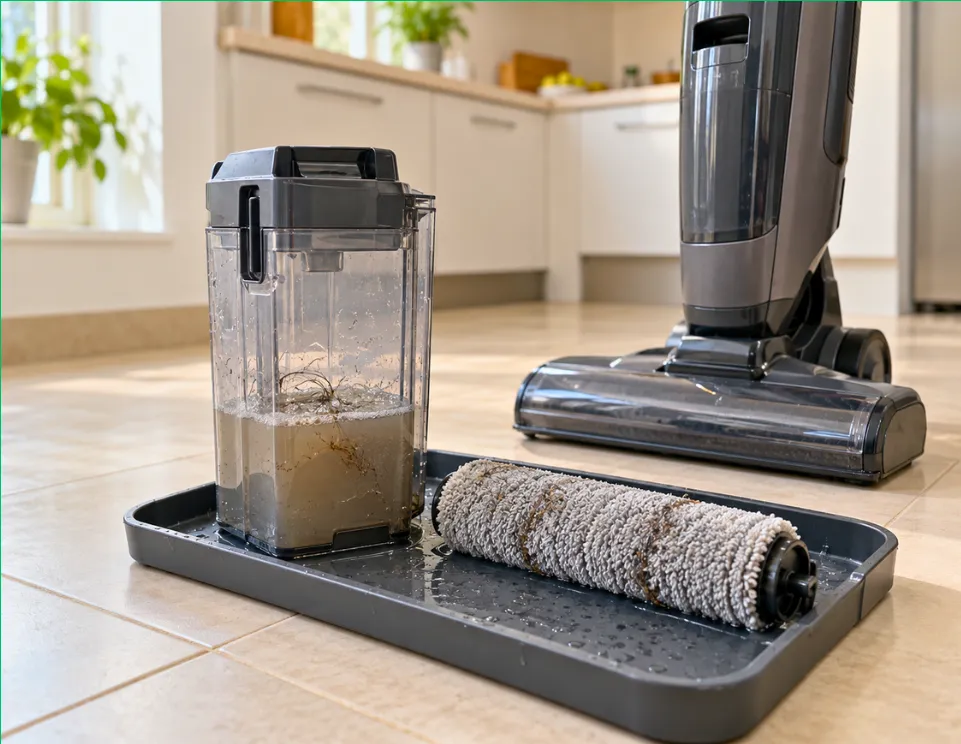
An upright vacuum mop must apply water, scrub the floor, and recover wastewater. Roller contact, liquid recovery, edge access, and maintenance all belong in the comparison.
Its suction figure cannot establish safe use on a particular floor. Follow both the machine’s surface restrictions and the flooring manufacturer’s care instructions. Our best wet-dry vacuums guide covers household floor washers, rather than garage shop vacuums.
Robot vacuums
A robot’s advertised pascal rating describes pressure under the manufacturer’s test conditions. It does not account for brush contact, navigation, missed areas, or how consistently the robot covers a room.
Use pickup and coverage results together when comparing the best robot vacuums. A robot that reaches the dirt consistently may be more useful than one with a larger pressure claim but poor coverage.
Frequently Asked Questions
Can a vacuum with lower air watts clean better?
Yes. Better brush contact, nozzle design, surface compatibility, or handling can produce a better cleaning result despite lower measured air power. First check whether the AW figures were measured comparably.
Does a HEPA filter automatically mean weaker suction?
No. Filtration performance and airflow resistance are different properties. Filter area, construction, condition, and the rest of the air path affect performance. Assess the complete machine rather than assuming that a filtration label determines its airflow.
What is a good CFM or air-watt rating?
There is no single minimum that reliably separates good and poor vacuums across every category. Use figures measured under comparable conditions within the same type of machine, then check pickup results with the intended tool. An unsupported numerical cutoff can rule out suitable cleaners or favor the wrong design.
Conclusion
CFM tells you how much air moves. Water lift describes pressure capability. Air watts combine pressure and flow at a stated operating point.
Use comparable air-watt figures when available, but make the purchase decision around cleaning results, floorhead suitability, usable runtime, filtration, and upkeep. The best power specification is one that helps explain effective cleaning in the configuration you will actually use.
Engr. Hm Jamal
Founder & Lead Technical EditorFounder of Wits Engineer, with a practical background in electrical and water systems. His product reviews focus on setup, performance, maintenance and the trade-offs that affect everyday ownership.