
Wits Engineer Product Testing Methodology & Lab Criteria
A result is useful when you can understand how it was obtained—and what it leaves unanswered.
Our product testing methodology connects controlled measurements with the jobs people need equipment to do at home. We evaluate cleaning performance, water-system operation, portable power, indoor-comfort equipment and practical tools, with attention to setup, maintenance and the cost of ownership. Wits Engineer has started a new testing lab and team. This page sets the requirements for that work. Our goal is hands-on evaluation of every product we review; an individual article must still identify what was actually tested, when it was evaluated and which findings come from research.
Team-led evaluation Product handling, recorded measurements and editorial review.
Comparable conditions Relevant settings, a defined task and a documented procedure. Clear evidence Measured findings kept separate from specifications and estimates.
Explore our testing standards
- Evidence & scope
- From selection to review
- Lab controls & records
- Vacuums & floor care
- Water systems
- Portable power
- Cooling & air quality
- Tools & equipment
- Results & recommendations
- Independence
- Retesting & corrections
- Technical references Inspecting controls, accessories and serviceable parts is one part of evaluation. Performance claims still need the relevant tests.
What our review evidence means
A product can be physically inspected without completing a performance test. A manufacturer’s runtime claim can be documented without reproducing it. Our reviews need to make those differences visible.
[TESTED] Performance evaluated
Our team carried out the tests or use described in the review. The article must state the scope; a tested cleaning result does not establish years of durability, certified filtration or every advertised feature.
[HANDLED] Physically inspected
We inspected the product or its controls, fit and construction. Handling alone does not support claims about measured pickup, battery endurance, contaminant reduction or long-term reliability.
[RESEARCH] Document-based assessment
The assessment uses identified documentation and other sources. It must not imply that we installed, used or measured the product. Third-party findings remain attributed to their source. Each reviewed product should carry one evidence status, including in a roundup. The new lab program does not retroactively change the evidence behind older articles. When a product moves from research or inspection to completed testing, its review needs the supporting findings before its status changes.
From product selection to a published review
The review begins with a buying question, rather than a score to fill. A compact vacuum for stairs and a large carpet cleaner solve different problems. Our process needs to reflect that difference.
Define the product and its purpose
Record the exact model, generation, regional version and supplied accessories. Select comparison products that serve a similar task. Note how the review unit was obtained and any relevant relationship with its supplier.
Check the instructions and prepare the unit
Follow the manual for assembly, charging, flushing, settings and operating limits. Record firmware or app versions where they affect behavior. Photograph identifying details and any damage or missing parts before evaluation. 3. ### Set the procedure before measuring
Define the surface, load or water conditions; the mode and attachment; the starting condition; and the endpoint. Decide which measurements answer the buying question. Any departure from that procedure needs a recorded reason.
Measure, reset and repeat where appropriate
Keep comparable runs consistent. Reset the test area and relevant product condition between runs. Record failures and interruptions alongside successful results, with the actual number of valid runs.
Use the product and examine the upkeep
Look beyond the headline test: carry it, position it, use its controls and perform the maintenance the manual requires. Explain awkward access, recurring consumables, storage demands and tasks that still need manual work. 6. ### Check the evidence behind the verdict
The team’s review process requires the figures, units, model details and conclusions to be checked against the test record. A disagreement or missing result should be resolved or disclosed before it becomes a recommendation.
Different products need different tasks: cleaning a seat, collecting debris and washing a surface cannot share one performance measure.
Lab criteria: conditions, instruments and repeatability
A small difference between two products means little if the setting, test material or starting condition changed. These controls are the basis of our new lab protocols; the review must identify which ones apply to its measurements.
Identify the sample Record the unit, accessories, condition, test date and operator. One tested unit provides evidence about that sample; it does not establish the failure rate of an entire model range. Keep the task consistent Use the same relevant surfaces, debris preparation, water conditions or electrical loads for a comparison. Record temperature, humidity, supply conditions and other environmental factors where they can affect the result. Match the instrument to the job Document the instrument, range, resolution and check or calibration status relevant to a measurement. A scale zero check is different from a documented calibration. We should not report more precision than the equipment and method support. Repeat short measurements The baseline protocol calls for at least three valid runs for short, repeatable bench comparisons such as timed flow or controlled pickup. Longer discharge, wear and ownership evaluations state their actual run count or duration. Exceptions need an explanation. Keep variation visible Retain individual readings and report a useful summary with the run count and, where relevant, the range. Repeat runs of one unit are not multiple product samples. A tiny numerical lead is not automatically a meaningful advantage. Record problems and method changes An interrupted run needs a reason for exclusion; it should not disappear because the result is inconvenient. A changed procedure, software update or replacement accessory needs a note before old and new results are compared.
Our records need enough detail to connect a published finding with its setup, readings and supporting photos or notes. Instrument checks and repeatability help control error, but they do not make an editorial test a certification test. Floor cleaning
How we evaluate vacuum cleaners and floor-care products
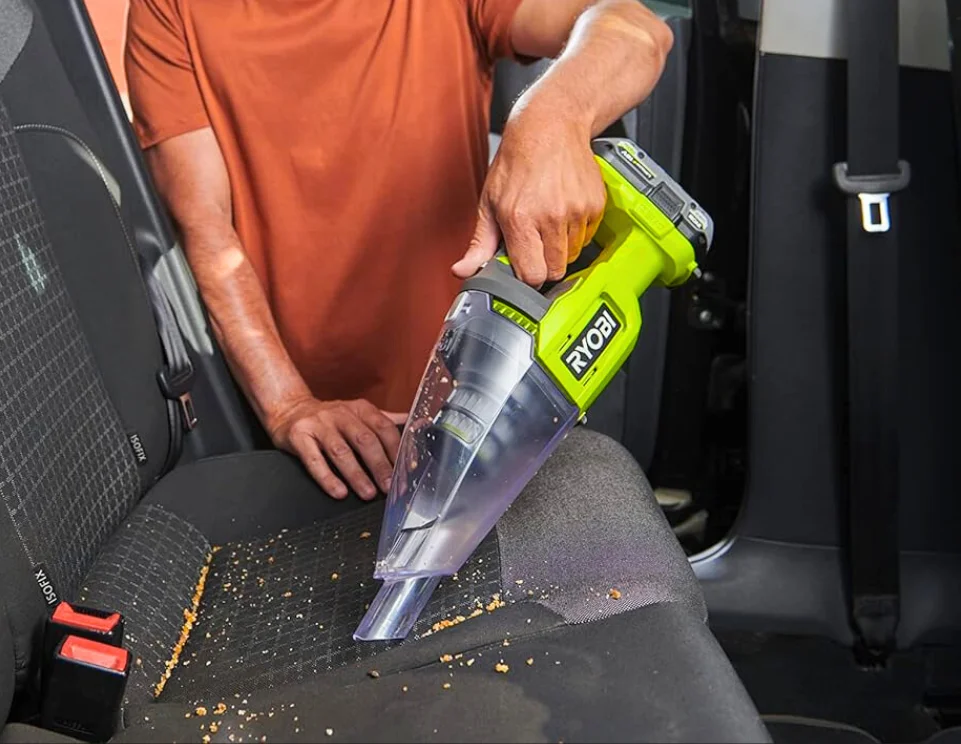 Upholstery cleaning: attachment reach and debris pickup are separate from floor-cleaning results.
Cleaning performance starts at the floor. Advertised suction, motor power and a list of cleaning modes cannot tell us how well a machine collects debris, negotiates a room or cleans up after a wet mess.
Dry vacuums: pickup, handling and runtime
For controlled pickup comparisons, specify the floor or carpet, debris type and starting mass, distribution, cleaning area, passes, head and power mode. Report the collection or residual-debris method used. Hair pickup and hair left wrapped around a brush are separate observations. Cordless runtime needs the attachment, surface, operating mode, starting charge and endpoint. A low-power run without a powered head cannot stand in for carpet-cleaning runtime. We also assess reach, carrying, floorhead steering, bin emptying and filter access.
Robot vacuums: coverage, obstacles and dock work
Use a documented layout with consistent furniture, floor transitions and obstacle placement. Record mapping and cleaning settings, firmware, completion time, missed areas, stalls and assistance. An obstacle result applies to the objects and lighting tested; it is not a promise that the robot will avoid every cable or pet accident. The dock is part of the product. Check the work required to refill water, empty waste, clean trays and maintain brushes or bags. Automatic washing or emptying does not eliminate upkeep.
Wet-dry washers, mops and carpet cleaners
Define the soil or stain, quantity, drying period, surface, solution, water setting and cleaning passes. Assess removal alongside residual moisture, streaks and edge access. A machine that leaves the surface very wet should not receive an uncomplicated cleaning advantage. Carpet extraction needs its own procedure, including wet and dry passes and the condition of the carpet before and after. Cleaning visible soil is different from proving sanitization. Self-cleaning cycles also need an inspection of the parts that still require rinsing or drying. Filter access, bin emptying and the cleanup required after use belong alongside cleaning performance. Filtration claims need separate evidence. A HEPA filter label does not establish whole-machine sealing. Unless the required particle-testing method and equipment are documented, we do not present a handling inspection or visible-dust check as a measured filtration-efficiency result.
Water systems
How we evaluate water filters, reverse osmosis and softeners
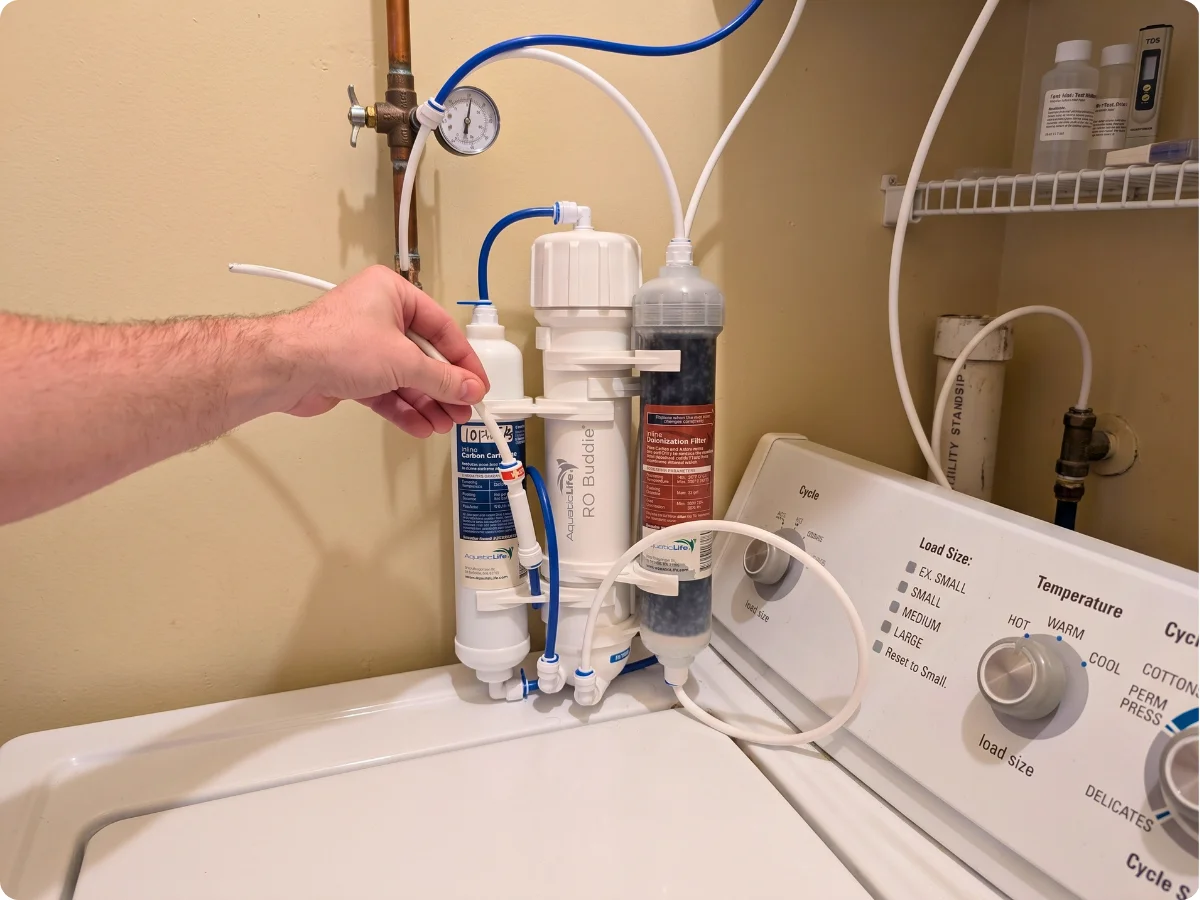 Water-system setup: connections, pressure and maintenance access form part of the evaluation.
A water-system review has two different jobs: assess how the equipment installs and operates, and establish what the evidence supports about treatment. An easy installation cannot prove contaminant reduction.
- Installation and access: cabinet clearance, connections, drain and electrical requirements, flushing, filter removal space and the work needed for maintenance.
- Operating conditions: source water, inlet pressure and temperature, conditioning or flush state, filter configuration and the sampling point.
- Flow and recovery: measured volume over elapsed time under stated conditions. For RO systems, measure product water and drain water over the same defined interval and explain whether flushing is included.
- Ownership: replacement-filter identity and availability, stated replacement intervals, cleaning requirements and any verified recurring-cost assumptions.
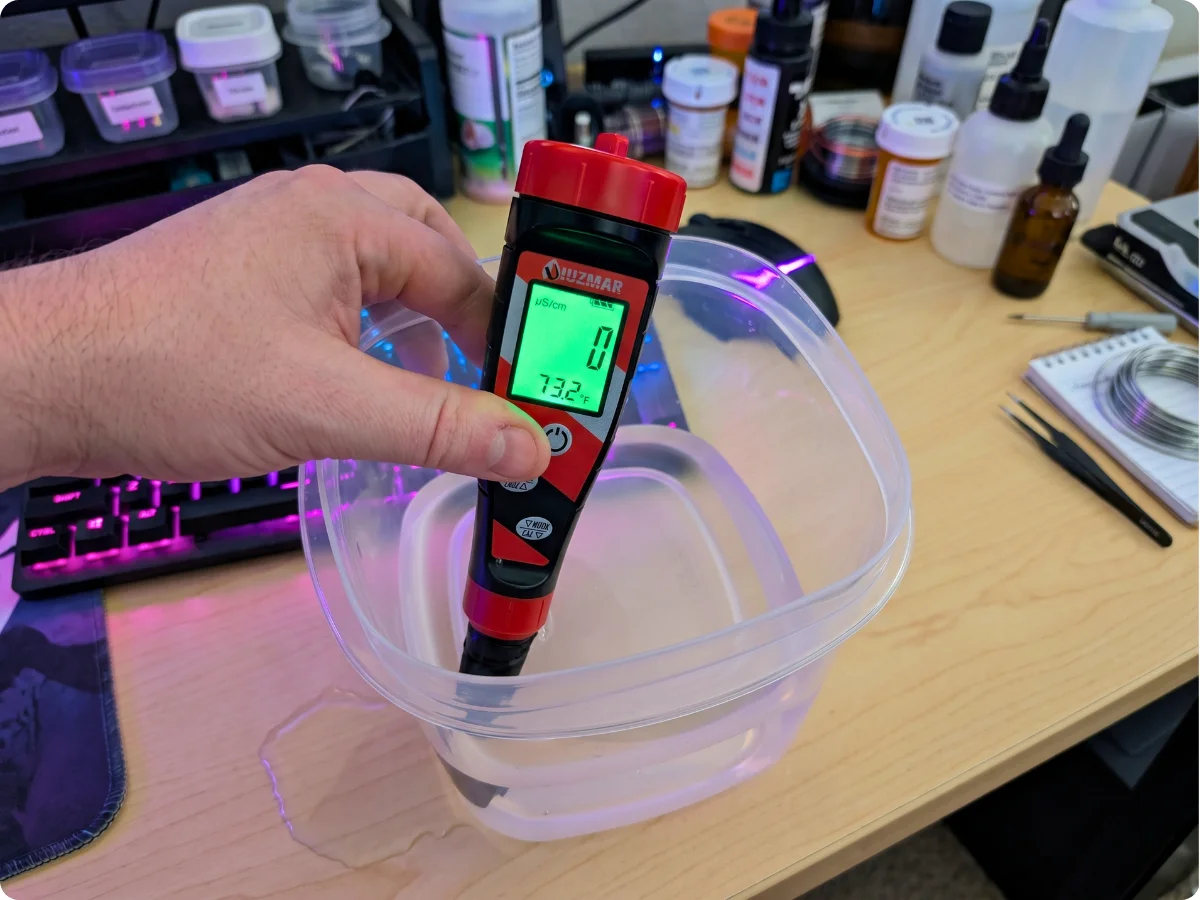 Conductivity is a supporting measurement. It does not identify individual contaminants or establish drinking-water safety.
A water-quality meter reading needs its sampling conditions and method. Conductivity and TDS are supporting indicators; neither alone identifies contaminants or establishes that water is safe to drink. Total dissolved solids (TDS) readings can describe changes in dissolved ionic content, including an RO system’s observed reduction under the recorded conditions. They do not identify individual contaminants, demonstrate microbiological safety or prove that water is safe to drink. Hardness also needs an appropriate hardness test; it cannot be read directly from a TDS value. For a contaminant claim, check the exact model and filter configuration in the named certifier’s listing or an applicable laboratory report. Record the specific substance, test conditions, capacity and reporting limits where available. A component listing or the words “tested to” are not equivalent to certification of the complete system. NSF’s explanation of water-treatment standards distinguishes aesthetic claims under NSF/ANSI 42, health-related reduction claims under 53, softeners under 44 and reverse osmosis under 58. A standard number does not establish every possible reduction claim. Our in-house flow and usability checks do not replace that claim-specific evidence.
Power & energy
How we evaluate portable power stations and backup equipment
Watt-hours describe energy; watts describe power. A unit can have enough stored energy for a task and still lack the output, connection or starting capability the appliance requires. For a capacity test, record the starting charge, output used, load, ambient conditions and discharge endpoint. Measure energy delivered at the output where suitable equipment is available. Keep rated battery capacity separate from measured usable output energy, and report AC, DC and USB tests separately. A charging result needs the input source, settings, starting and ending charge, and elapsed time. Charging results need the input source, settings, starting and ending charge, elapsed time and any interruptions. A solar-input rating is not an achieved charging result; an outdoor solar test also needs panel details and recorded conditions. A cycle-life specification remains a manufacturer claim unless the relevant cycling work has actually been completed. Practical checks include carrying, port access, display behavior, fan noise and performance with the stated loads. A successful start of one appliance does not establish universal motor-starting compatibility or verify a headline surge rating. Backup transfer-time claims need a method capable of measuring the event; simply observing that a device stayed on is not a precise timing test.
Cooling & air quality
How we evaluate air cleaners and indoor-comfort equipment
An air purifier, a fan and an air conditioner should not share a single performance test. Each needs a procedure matched to what it is intended to change in the room. For an in-room air-cleaner evaluation, record room volume, placement, doors and windows, fan setting, sensor location, background readings and elapsed time. Changes in room particle readings are specific to that setup. They are not automatically a Clean Air Delivery Rate (CADR) measurement or proof of gas removal. Where an exact model has an AHAM Verifide listing, identify its verified smoke, dust and pollen CADR separately from our observations. The EPA’s guide to air cleaners explains why particle filtration and gas removal require different evidence. A particle-count improvement cannot substantiate a claim about every indoor pollutant. Cooling and dehumidification comparisons need room conditions, placement, operating mode, test duration and the relevant exhaust, drainage or installation arrangement. For fans, assess airflow at defined positions rather than treating air movement as measured refrigeration capacity. Across these products, document power use, sound conditions, controls, filter care and access for cleaning.
Tools & equipment
How we evaluate maintenance tools and garage equipment
The task determines the test. Record the material, workpiece, battery or supply, attachment and operating setting before comparing speed, handling or output. A compact tool should be judged against the work it is designed to perform. Hose reach, maneuverability, storage and debris collection all affect how useful a shop vacuum is in that space. For a tire inflator, useful records include tire size, starting and target pressure, battery state or supply, inflation time, gauge comparison and the pressure after automatic shutoff. A result on one tire does not establish performance on a much larger tire, and the displayed pressure needs checking against a suitable reference. For a jump starter, identify the vehicle, engine, ambient conditions, battery condition and starting attempt. A successful vehicle start is an observation under those conditions; it does not independently measure the advertised peak-current or cold-cranking rating. Clamps, cables, controls and recharge requirements also affect practical usefulness. Power-tool assessments should state the fixture or material used and avoid claiming measured torque, accuracy or service life without the appropriate procedure and instruments. Record interruptions, thermal limits and the parts or consumables needed to keep working.
How results become recommendations
Raw measurements answer specific questions. The verdict explains what those answers mean for a buyer. Strong carpet pickup may matter less than weight for someone carrying a vacuum upstairs; a fast water system may still be inconvenient if its replacement filter cannot be removed inside the cabinet. Compare results only when the procedure and conditions support the comparison. A reference average must identify the comparison set and method; it should not be presented as an industry average. A score from another publication belongs to that publication’s system and cannot be combined with ours as though the scales were identical. Where we publish a numerical score, the review needs to explain the criteria, scale and any weights used. An unmeasured item should be marked as unmeasured, rather than silently assigned a favorable value. Where a defensible numerical model is unavailable, a clear written verdict is more useful than a precise-looking total. What to look for beside a result
| Finding | Context that makes it useful | What it does not establish |
|---|---|---|
| Runtime | Mode, attachment or load, starting state and endpoint. | Runtime in every mode or with every appliance. |
| Noise in dBA | Distance, position, mode, background and instrument. | A simple percentage difference in perceived loudness. |
| Water flow | Volume, time, pressure, temperature and system state. | Removal of a particular contaminant. |
| Room particle change | Room volume, sensor placement, fan mode and time. | Certified CADR or removal of gases. |
| Short-term use | Actual dates, tasks and maintenance observations. | Years of reliability or a population-wide failure rate. |
| Our recommendation should identify who the product suits, its material drawbacks and any condition that changes the choice. Price-based judgments need the price and date used. A serious limitation should remain visible even when other results are strong. |
Editorial independence and the limits of our lab
Wits Engineer maintains a no-sponsorship policy for product reviews. Payment does not buy a favorable verdict or a position in a recommendation list. Amazon affiliate commissions help fund the publication, while recommendations must remain supported by the product evidence and the reader’s needs. A review unit’s source and relevant commercial relationships belong in its disclosure. Supplier specifications should be checked, and a supplier’s explanation of a problem should remain distinguishable from a result the team reproduced. Engineer Md Jamal, founder and CEO of Wits Engineer, leads the publication’s editorial direction. His electrical engineering background and more than 13 years of experience in appliance performance and water treatment inform the questions behind this work. Results still depend on the recorded procedure and evidence. Our lab performs editorial product evaluation. A Wits Engineer review is not a safety certification, a regulatory approval or a claim of laboratory accreditation. Referencing a technical standard does not mean that every requirement of that standard was performed. Any claim of testing to a named standard needs the exact scope and supporting record. Tests must stay within the product’s intended use and documented operating limits. Where a claim requires specialist facilities, validated methods or a qualified external laboratory, identify that evidence rather than substituting a simple bench check. If the necessary evidence is unavailable, narrow the conclusion.
Long-term use, retesting and corrections
Initial performance and long-term ownership answer different questions. A review should state the actual evaluation period. Planned follow-up is not completed long-term testing, and a manufacturer’s service-life estimate is not our measured lifespan. Retesting may be needed after a meaningful firmware change, revised accessory, replacement unit, method change or credible report of an issue. Record what changed and which findings were rechecked. Results from different protocol versions should not be ranked together without a valid basis for comparison. Material corrections need a visible explanation of what changed and whether the verdict was affected. An article’s update date should reflect a substantive review or change, rather than implying that an unchanged product was tested again.
If you spot a problem, send the article URL, exact model, disputed detail and any relevant manual, notice or supporting material. Ownership reports can help the team identify an issue worth investigating; they remain separate from controlled measurements.
Technical references and further reading
These references explain relevant measurement principles and claim limits. They are not endorsements of Wits Engineer or evidence that a particular product completed a test.
- IEC 62885-2:2026 — the published scope of performance measurement for mains-operated and cordless dry vacuum cleaners. Our category procedures need their own documented scope.
- NIST: analysis of repeatability — understanding variation in repeated measurements.
- CDC: guidelines for testing well water — the distinction between water-quality indicators and tests for specific germs or chemicals.
- AHAM: air filtration standards — what separate smoke, dust and pollen CADR ratings describe.