6 Best Water Softener Systems + 1 Salt-Free Alternative: Tested
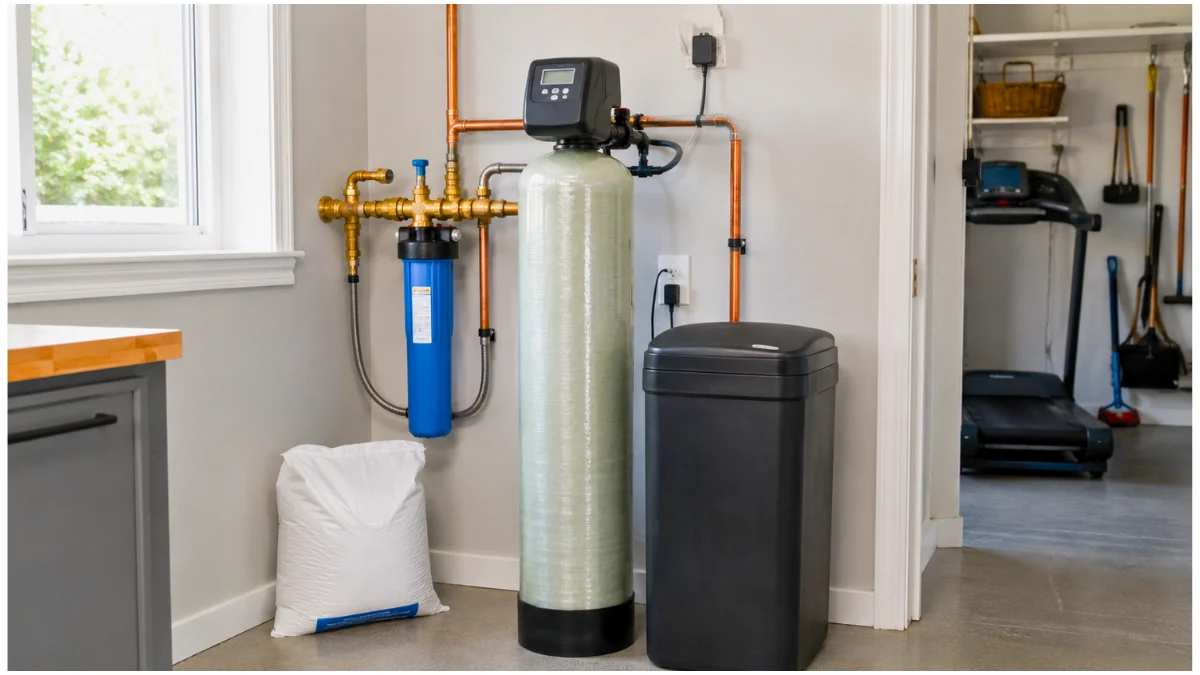

One mistake I would avoid when buying a water softener is choosing by grain capacity alone. After evaluating these systems, installation layout, water chemistry, programming, regeneration behavior, and how much attention you want to give the equipment matter just as much as the number printed on the tank.
For tested hard private-well water, the SoftPro Elite HE is my first choice when any necessary pretreatment is already accounted for. The Aquasure Harmony 48,000-grain system stands out for a conventional replacement installation, while the GE GXMD30W is the one I would choose when smart monitoring matters more than maximum capacity.
The Fleck 5600SXT, iSpring WCSTB45KG, and Kenmore 350 fill more specific roles. I have also separated the Aquasana Rhino system from the main rankings because its salt-free conditioner controls scale rather than removing hardness minerals.
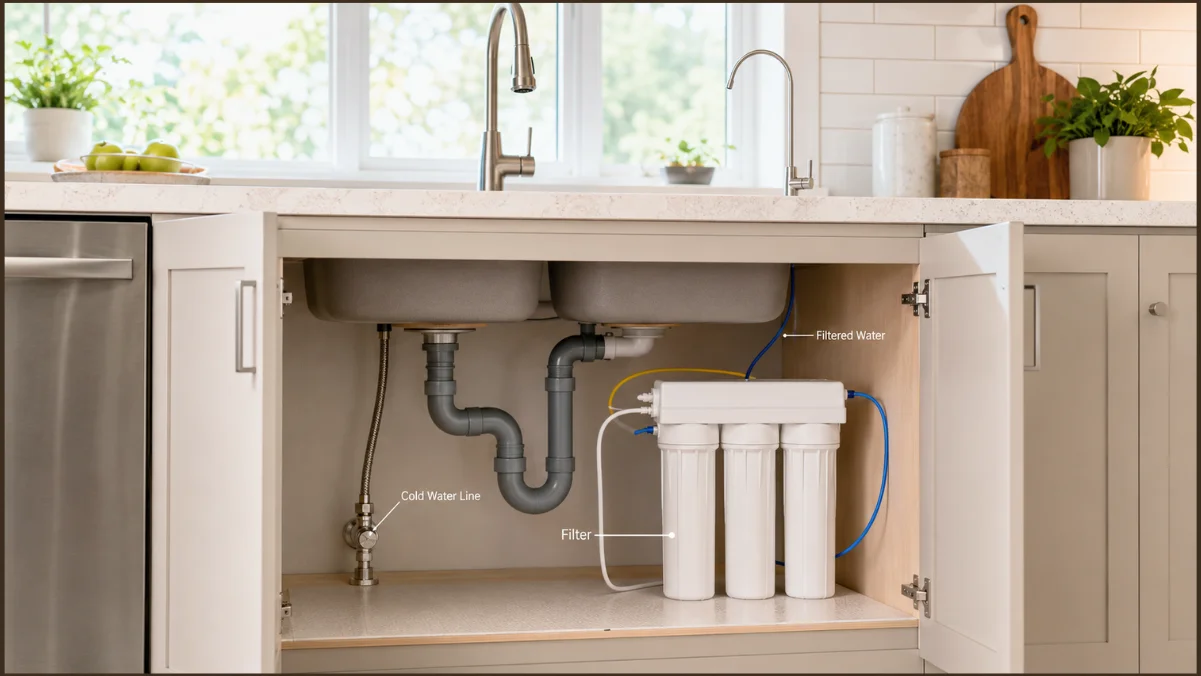
|| Read more about Water Filtration Systems for Homes: Under-Sink, Whole-House, Countertop, RO & Pitcher Picks.
Best Water Softener Systems at a Glance
| Product | Best Fit | What Stood Out | Main Compromise |
|---|---|---|---|
| SoftPro Elite HE 64K | Hard private-well water | Evaluated in a treated private-well setup | Needs correct pretreatment and more space |
| Aquasure Harmony 48K | Replacement installations | Easy adjustment after real-world setup | DIY installation still needs plumbing experience |
| GE GXMD30W | Smart monitoring | Useful SmartHQ water and salt monitoring | Lower capacity and some app limitations |
| AFWFilters Fleck 5600SXT 48K | Serviceability | Conventional, serviceable valve architecture | No connected monitoring |
| iSpring WCSTB45KG 45K | Conventional local-control setup | 1-inch connections and local controls | Large two-tank footprint |
| Kenmore 350 | Smaller homes and tight spaces | Compact all-in-one cabinet | Lower capacity than larger systems |
| Aquasana Rhino + Conditioner + UV | Salt-free alternative | Filtration, scale control, and UV without brine | Does not actually soften water |
Our Top Picks
Detailed product reviews
My Pick for Tested Hard Well Water: SoftPro Elite HE 64,000-Grain
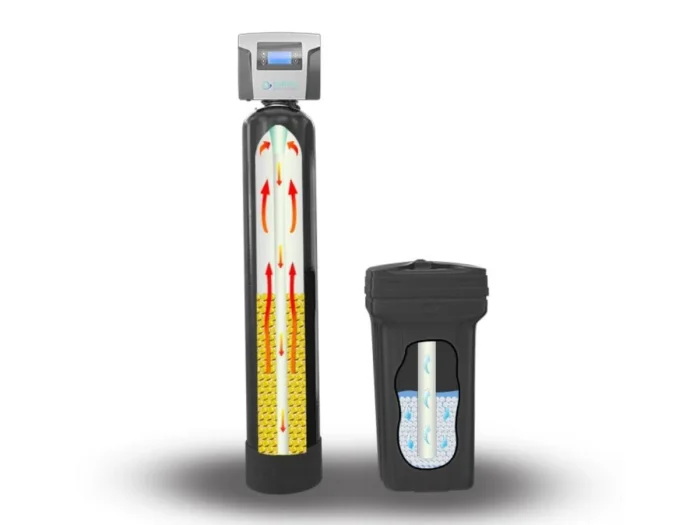
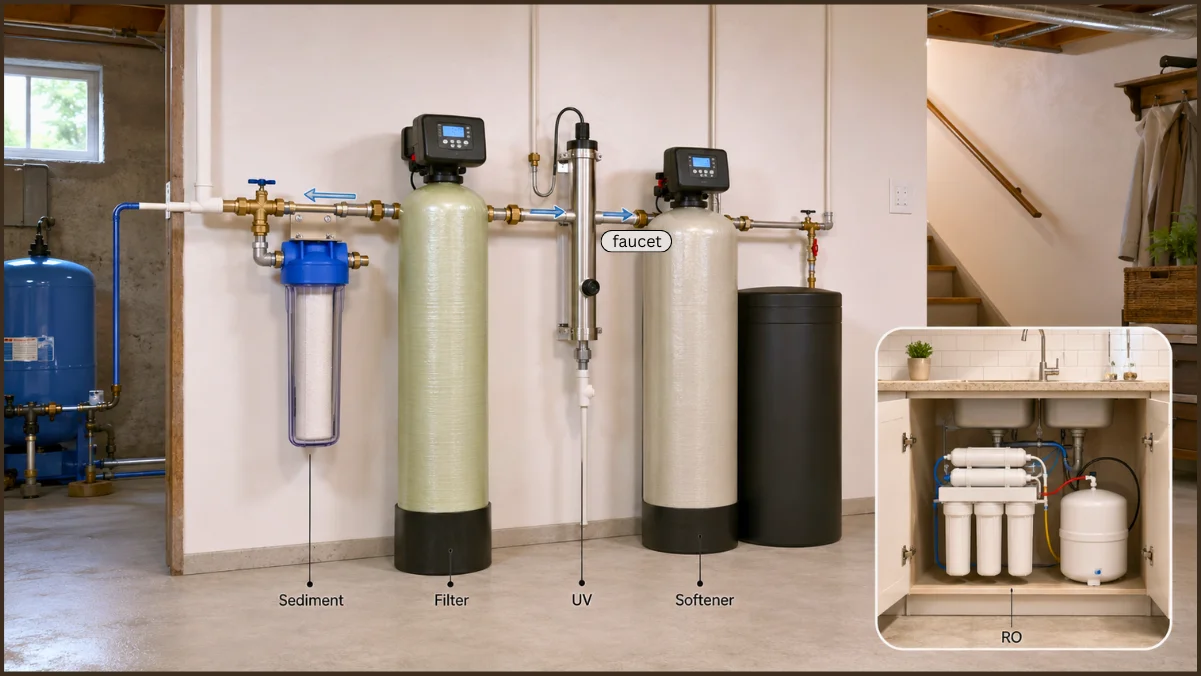
The SoftPro Elite HE is my first choice here for a home with tested hard well water and enough space for a traditional two-tank system. I evaluated the SoftPro Elite platform on a private-well installation that already had sediment filtration and UV treatment. The exact capacity of that tested Elite unit was not confirmed, so my hands-on observations apply to the platform; the 64,000-grain configuration itself is based on current product documentation.
The preloaded resin removes one messy setup step, and the bypass, brine tank, and control head are easy to identify. Main-line plumbing, drain routing, tank placement, and correct positioning within the well system still require planning. I also needed the manual during initial programming rather than treating the controls as self-explanatory.
During the evaluation, I noticed changes in water feel, soap behavior, and the amount of new mineral residue around fixtures. The more important conclusion, however, is what the evaluation did not establish.
Because upstream treatment was already present, I would never tell a homeowner that the SoftPro alone will correct substantial sediment, sulfur odor, manganese, microbial contamination, or every iron problem.
The separate brine tank takes more room than a cabinet design, but it is easy to inspect and refill.
Pros
- True ion-exchange softening
- Well-water-focused configuration
- Demand-based regeneration
- Accessible service layout
Cons
- Requires considerable installation space
- Setup deserves careful programming
- Salt and drain are required
- Other well problems may need pretreatment
Best for: Tested hard well water where hardness is the problem the softener is actually being asked to solve.
Choose something else if: Iron, sulfur, sediment, bacteria, or another untreated contaminant is the dominant water problem.
A Strong Replacement Option: Aquasure Harmony 48,000-Grain
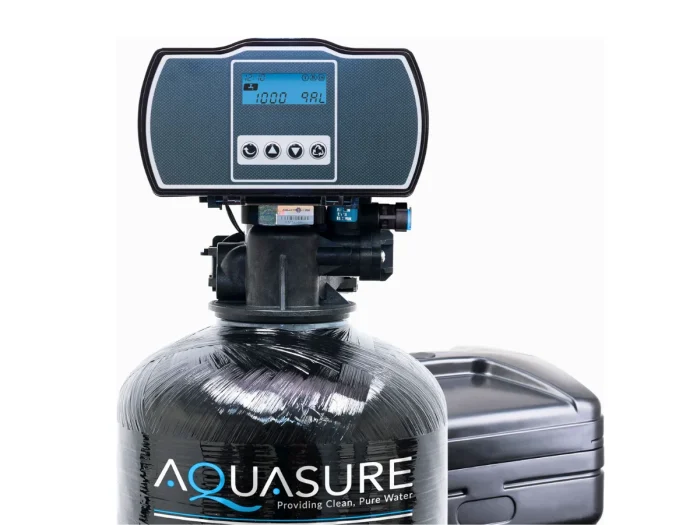
The most useful thing I learned from the Aquasure was not its 48,000-grain label. It was how easy the system was to correct when my original regeneration calculation turned out to be too optimistic.
I installed it as a replacement for an older softener. Marking the direction of flow and photographing the existing plumbing from several angles before removing anything made the job much easier. If you already have some light plumbing experience, replacing an existing system is manageable. I would not recommend making this your first plumbing project.
Once it was running, hardness returned earlier than my initial regeneration setting predicted. I shortened the interval, and the system stayed consistent afterward. The digital control made that correction simple, reinforcing why usable settings matter more than the advertised capacity alone.
After six months in a two-adult household, the Aquasure has needed little day-to-day attention beyond normal salt and system checks. That balance of conventional construction, adjustable metered regeneration, and straightforward ownership is why the Aquasure remains one of the easier systems here to recommend for an existing-softener replacement.
I would buy the Aquasure again for a replacement installation where the plumbing layout is already established. I would hire a plumber if this were my first attempt at modifying a home's main water line.
Best Smart Softener: GE GXMD30W
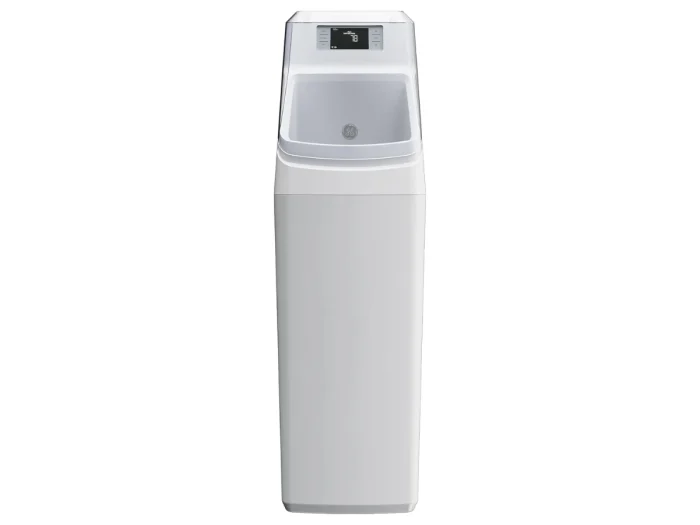
SmartHQ was one of the GXMD30W's most useful differences from my previous softener. It connected easily, and I used it to check current household water flow, salt status, low-salt alerts, and water-use history without going to the unit.
The physical controls remain fully functional without Wi-Fi, which proved important when Vacation Mode produced an error through the app even though I could enable the same mode normally from the softener.
The GE also replaced an older unit that had visible sludge buildup at the bottom. I preferred the GXMD30W’s integrated self-cleaning approach, and after installation the water felt noticeably softer, showering was more comfortable, and laundry no longer had the same rough feel I had noticed before.
Space still needs checking carefully. Despite its cabinet-style design, the GXMD30W was larger than the softener it replaced, so checking installation clearance before ordering matters. The optional remote shutoff valve is also not automatically included, so buyers expecting complete remote shutoff capability should verify what comes with the package.
What I like
- SmartHQ monitoring is genuinely useful
- Good onboard controls
- Useful salt alerts and usage history
- Cleaner ownership experience than my previous unit
What I would change
- Vacation Mode produced an app error
- Remote shutoff requires an additional component
- Lower capacity than larger picks
Choose the GE when you want to know what the system is doing without walking to the utility room. If remote monitoring is not important, some of the larger conventional systems here offer more softening capacity and simpler local controls.
For Buyers Who Prioritize Serviceability: AFWFilters Fleck 5600SXT 48,000-Grain
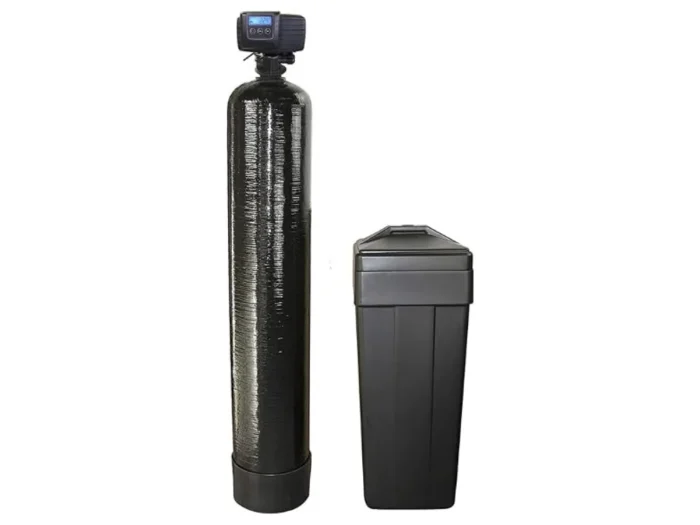
The Fleck 5600SXT earns its place for almost the opposite reason that the GE does. There is no app, cloud account, remote water-use dashboard, or smart-home layer. What you get instead is a conventional digital metered valve with physical controls and a familiar two-tank layout.
That architecture matters if long-term serviceability is high on your list. The valve, bypass, brine system, and normal service points are exposed and accessible rather than hidden behind a proprietary connected platform. The control panel also shows remaining capacity and gives direct access to regeneration and programming rather than hiding basic operation behind software.
The exact AFW configuration reviewed here uses 1.5 cubic feet of 10% crosslink resin. This is particularly relevant for chlorinated municipal water where resin resistance to chlorine exposure matters. It is less important on an untreated private well unless chlorine is part of the treatment process.
The trade-off is a more conventional equipment-room installation: two tanks, drain routing, careful initial programming, and manual salt monitoring.
The Fleck is the model I would shortlist when local controls, conventional components, and future service access matter more than remote monitoring.
Pros
- Conventional serviceable architecture
- Fleck 5600SXT metered valve
- 10% crosslink resin
- Full local control
Cons
- Large two-tank installation
- More technical programming
- No remote monitoring
- Still requires separate treatment for difficult well-water contaminants
iSpring WCSTB45KG 45,000-Grain: A Straightforward Conventional Option
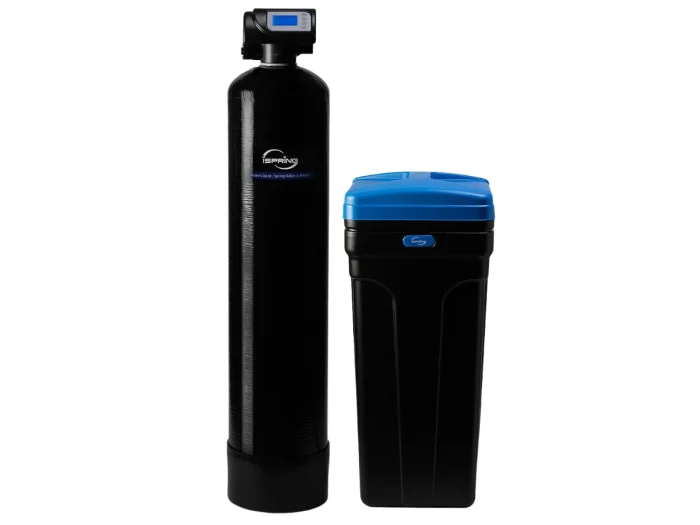
The iSpring is not here because it does something radically different from the Fleck. Its case is simpler: a prefilled resin tank, 1-inch plumbing connections, automatic regeneration, and direct local controls without Wi-Fi or an app.
Installation needs to be planned before the system arrives. The separate resin and brine tanks require floor space, while the main line, power source, regeneration drain, overflow line, and service clearance all need to work together. That makes it a poor choice for a cramped mechanical room even though the individual tanks do not look unusually large on paper.
All important operation happens at the controller. Once hardness and regeneration settings are correct, the system can manage its normal cycles without an app or cloud service. For some homeowners that is a limitation; for others it is exactly the appeal.
I would choose the iSpring when straightforward local operation and a conventional two-tank setup matter more than connectivity. If standard Fleck valve architecture and component-level serviceability are the priority, the AFW model is the more obvious alternative.
Why consider it
- Prefilled resin
- 1-inch plumbing compatibility
- Direct local controls
Main compromise
- Two-tank footprint
- No remote monitoring
Best Cabinet-Style Option: Kenmore 350 (625.383500)
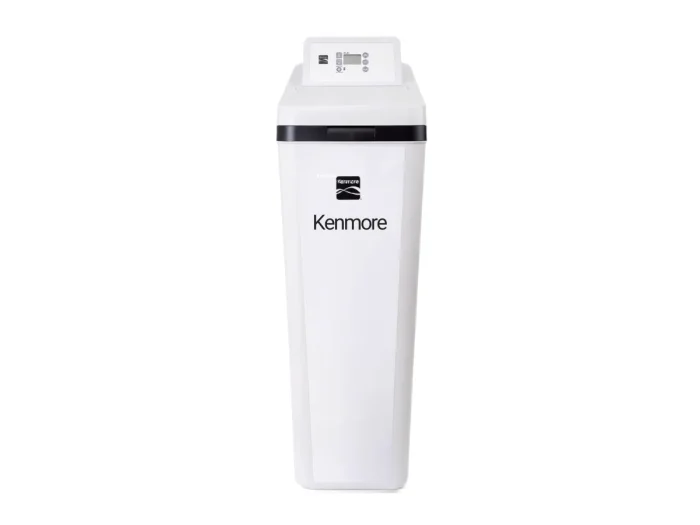
The Kenmore 350 solves a simpler problem than the larger two-tank systems: what if you need ion-exchange softening but do not want a resin tank and brine tank occupying separate areas of the utility room?
Its resin and salt storage are contained in one cabinet, producing a much cleaner installation. That compactness is the reason I would consider it—not because 32,000 grains is somehow an ideal universal capacity.
Kenmore positions the 350 for roughly one-to-four-person households, which is a useful starting point rather than a substitute for sizing by hardness and household demand. I would hesitate to use it for a large family, very hard water, or a home with heavy simultaneous demand when one of the larger systems is available.
Kenmore also publishes a clear-water-iron capability for the 350. That should not be mistaken for a claim that it solves every iron problem. Dissolved clear-water iron is very different from visible red iron, iron bacteria, sediment, sulfur odor, or broader well contamination.
Compared with the GE, the Kenmore is the simpler cabinet choice. You lose remote water monitoring and phone alerts, but you also remove the app from the ownership equation entirely.
Pros
- Compact all-in-one cabinet
- Demand-based regeneration
- Straightforward local operation
- Useful published clear-water-iron capability
Cons
- Lower-capacity class
- No smart monitoring
- Less-open internal service access
- Limited role in difficult well water
Choose the Kenmore when installation space is the constraint. Choose a larger two-tank model when household demand is the bigger problem.
Salt-Free Alternative: Aquasana Rhino + Conditioner + UV (WH-1000-CS-UVS-B)
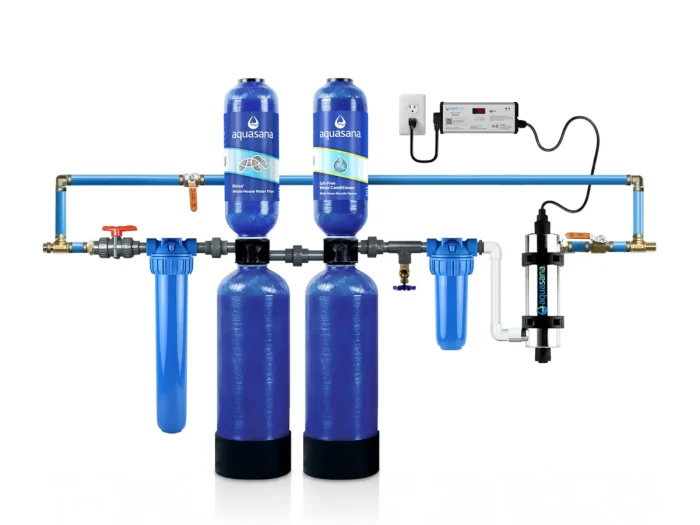
I separated the Aquasana from the main rankings deliberately. Calling it another “water softener” would make the comparison misleading.
The salt-free conditioner does not remove calcium and magnesium through ion exchange. Instead, it is intended to make those minerals less likely to form persistent scale. That can be useful, but it is not the same outcome as softened water.
What makes the Aquasana interesting is the rest of the treatment train. It combines sediment prefiltration, Carbon/KDF filtration, salt-free conditioning, post-filtration, and UV. For a municipal-water homeowner concerned with chlorine taste and odor, broader whole-house filtration, scale management, and avoiding salt or brine discharge, that combination may make more sense than a conventional softener.
Ownership does not become maintenance-free. You trade salt loading and regeneration for multiple filters and UV maintenance. Installation is also substantially more complicated than the word “salt-free” might suggest because the complete system contains several treatment stages and requires enough space to service them.
Makes sense when
- Salt avoidance matters
- Whole-house filtration matters
- Scale control is sufficient
Not the right choice when
- You want hardness minerals removed
- Traditional softened-water results are the goal
Choose the Aquasana when filtration and salt-free scale control are the goal. If you specifically want calcium and magnesium removed, stick with one of the six ion-exchange softeners above.
Compare the products
Choose the products you want to compare. Ratings retain each product’s original rubric.
| Product | My Pick for Tested Hard Well Water: SoftPro Elite HE 64,000-Grain | A Strong Replacement Option: Aquasure Harmony 48,000-Grain | Best Smart Softener: GE GXMD30W | For Buyers Who Prioritize Serviceability: AFWFilters Fleck 5600SXT 48,000-Grain | iSpring WCSTB45KG 45,000-Grain: A Straightforward Conventional Option | Best Cabinet-Style Option: Kenmore 350 (625.383500) | Salt-Free Alternative: Aquasana Rhino + Conditioner + UV (WH-1000-CS-UVS-B) |
|---|---|---|---|---|---|---|---|
| Check current price | Check price on Amazon ↗ | Check price on Amazon ↗ | Check price on Amazon ↗ | Check price on Amazon ↗ | Check price on Amazon ↗ | Check price on Amazon ↗ | Check price on Amazon ↗ |
What I Learned From Evaluating These Water Softeners
A few things became more important than the headline specifications once I looked at how these systems actually fit into a home.
The grain number does not size the system for you
The Aquasure made this especially clear. My original regeneration calculation was too optimistic for our moderately to highly hard water. Hardness returned before the interval I had expected, so I shortened the regeneration setting. The controls made the correction straightforward, and the system stayed consistent afterward.
That experience is why I would not choose a softener from the grain number alone. Start with measured hardness and actual household use, then make sure the regeneration settings match the conditions in the home.
Smart features can be genuinely useful, but local controls still matter
GE’s SmartHQ app was not just a novelty. I found its real-time water-flow information, salt monitoring, alerts, and usage history useful in day-to-day ownership.
It was not flawless. Vacation Mode produced an error through the app while the same function worked correctly from the softener itself. That changed how I look at connected softeners: I value the remote monitoring, but I still want the equipment to remain fully usable without the phone.
Well-water treatment has to be considered as a system
The SoftPro Elite platform was evaluated on private well water with sediment filtration and UV treatment already upstream. That context matters.
I can reasonably judge its role as the softening stage, but I would not use that evaluation to claim the SoftPro itself solved sediment, microbial contamination, sulfur, or every form of iron. A good well-water installation starts with the water test and builds the treatment train around the actual problems present.
|| Our guide covers water filtration systems for well water, including options for iron, sulfur odor, sediment, bacteria, hard water, low pH, and drinking-water treatment.
Two tanks are inconvenient for space but useful for access
SoftPro, Aquasure, Fleck, and iSpring all require more planning than a cabinet unit. You have to account for the resin tank, brine tank, plumbing, drain routing, power, and room to load salt.
The upside is access. A separate brine tank is easy to open and inspect, while exposed valves and service points are easier to reach than components packed inside an appliance-style cabinet.
A salt-free conditioner is not the same as a water softener
I deliberately did not rank the Aquasana with the six ion-exchange softeners.
Its conditioner can help manage scale, and the full system also adds filtration and UV treatment, but calcium and magnesium remain in the water. That is a fundamentally different result from ion exchange.
If you specifically want hardness minerals removed, choose an ion-exchange softener.
|| Our under-sink water filters provide cleaner drinking water without the need to fill pitchers, buy bottled water, or clutter your kitchen counter.
How I Evaluated These Systems
I did not rank these systems by the largest advertised grain capacity or by laboratory-style reduction percentages that may not predict another home's results.
I focused on what matters once a homeowner actually has to install and live with the equipment:
- installation and plumbing requirements;
- initial programming;
- regeneration controls;
- salt access;
- maintenance and serviceability;
- cabinet versus two-tank layout;
- water-source compatibility;
- smart versus local controls;
- and the limitations that determine when another treatment method is required.
The evidence is not identical for every product. Where I had product-specific hands-on observations, I used them directly. Where a conclusion came from exact-model documentation or engineering analysis rather than firsthand use, I did not present it as a personal observation. Product specifications and operating requirements were checked against documentation for the exact configuration wherever possible.
I also do not treat one home’s measured water result as a universal prediction for another house. Source-water chemistry, plumbing, household use, programming, pressure, pretreatment, and installation conditions can all change the outcome.
How to Choose the Right Water Softener
First decide whether you actually need softening
If your goal is to remove calcium and magnesium hardness, choose an ion-exchange softener.
If you mainly want scale control without salt, a conditioner may be enough—but do not expect it to produce the same water as a salt-based softener.
That distinction should come before brand, grain capacity, app features, or price.
Test the water before sizing the equipment
For municipal water, start with the utility's current water-quality information and a hardness result for the home.
Private wells need broader testing because hardness can exist alongside iron, manganese, sediment, sulfur odor, pH problems, or microbiological contamination. A softener should not become the default solution for every symptom simply because the water comes from a well.
The SoftPro installation is a good example. Because sediment and UV treatment were already upstream, I could evaluate the softening stage without pretending it performed those other treatment jobs.
Do not choose by grain capacity alone
A larger grain number describes how much hardness capacity is potentially available between regenerations. It does not automatically tell you:
- how efficiently that capacity will be used;
- how often the system will regenerate;
- whether the programming matches your water;
- or whether the household’s peak water demand fits the system.
My Aquasure setup reinforced this. The initial regeneration calculation looked reasonable but proved too optimistic in actual use. Correct programming mattered more than the number printed in the product name.
Think about ownership style
If remote monitoring and salt alerts matter most, the GE GXMD30W is the clearest fit. The Fleck 5600SXT makes more sense when conventional serviceability matters more than connectivity, while the Kenmore 350 suits homes where a compact cabinet is the priority.
For tested hard private-well water, I would start with the SoftPro Elite HE when the rest of the treatment setup is appropriate. The Aquasure Harmony is especially compelling as a replacement for an existing conventional softener because its controls were straightforward to adjust after installation. The iSpring WCSTB45KG fits buyers who want a traditional two-tank system with 1-inch connections and direct local control.
Plan the installation before ordering
A traditional softener normally requires some combination of:
- access to the incoming water line;
- a regeneration drain;
- electrical power;
- a bypass;
- enough floor space for the equipment;
- room to load salt;
- and safe routing of drain and overflow lines.
Two-tank and cabinet systems solve the same hardness problem differently: two-tank layouts usually provide more open component access, while cabinet systems reduce the installed footprint.
Which Water Softener Should You Choose?
Start with the water, not the brand. A hardness test—and broader testing for a private well—should determine what the treatment system actually needs to do before grain capacity, smart features, or price enter the decision.
For tested hard well water, the SoftPro Elite HE is my first choice here when the rest of the treatment train is appropriate for the water chemistry. The GE GXMD30W makes the strongest case when remote monitoring matters, while the Kenmore 350 is the most practical cabinet-style option when installation space is tight.
Aquasure is especially compelling as a replacement for an existing conventional softener because its controls made it straightforward to correct my initial regeneration setting. The Fleck and iSpring make more sense for buyers who prefer conventional two-tank equipment and direct local control, with the Fleck placing more emphasis on serviceable valve architecture.
I would keep the Aquasana outside the softener ranking. Its filtration, UV, and salt-free conditioning can be useful, but it does not remove hardness minerals the way the six ion-exchange systems do.
The final decision comes down to three things: what is actually in the water, how much demand the household places on the system, and how you want to install and maintain it.
This section is ready for your content in the CMS.
Engr. Hm Jamal
Founder & Lead Technical EditorFounder of Wits Engineer, with a practical background in electrical and water systems. His product reviews focus on setup, performance, maintenance and the trade-offs that affect everyday ownership.