Best Whole House Water Filtration Systems of 2026
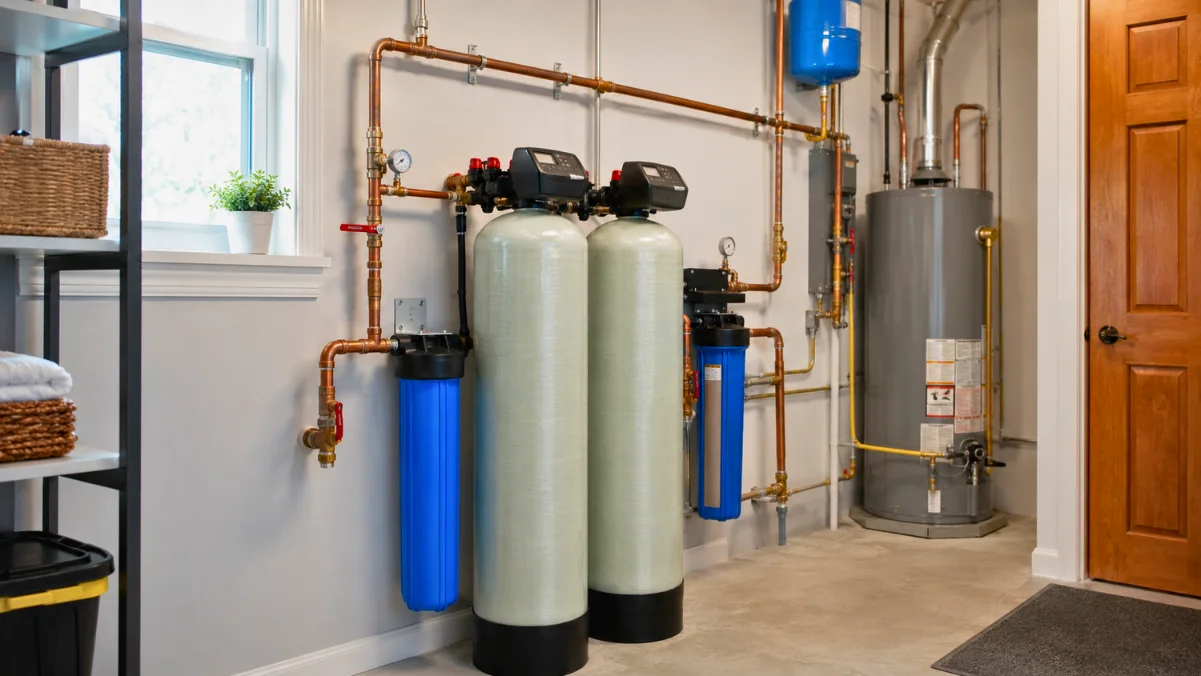

Choosing the best whole house water filtration system starts with knowing what is in your water. A large tank or extra filter stages will not help if they treat the wrong problem. Instead, match the system to your water source, contaminants, household demand, and plumbing size. Then check whether you have enough room to install and maintain it.
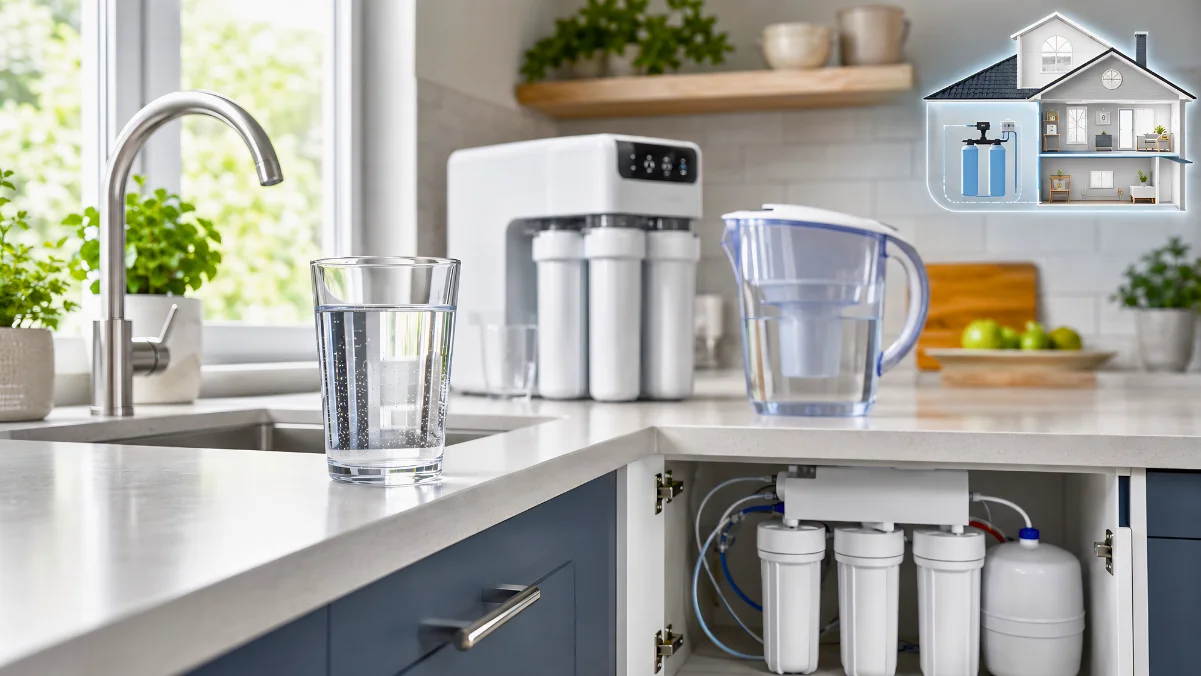
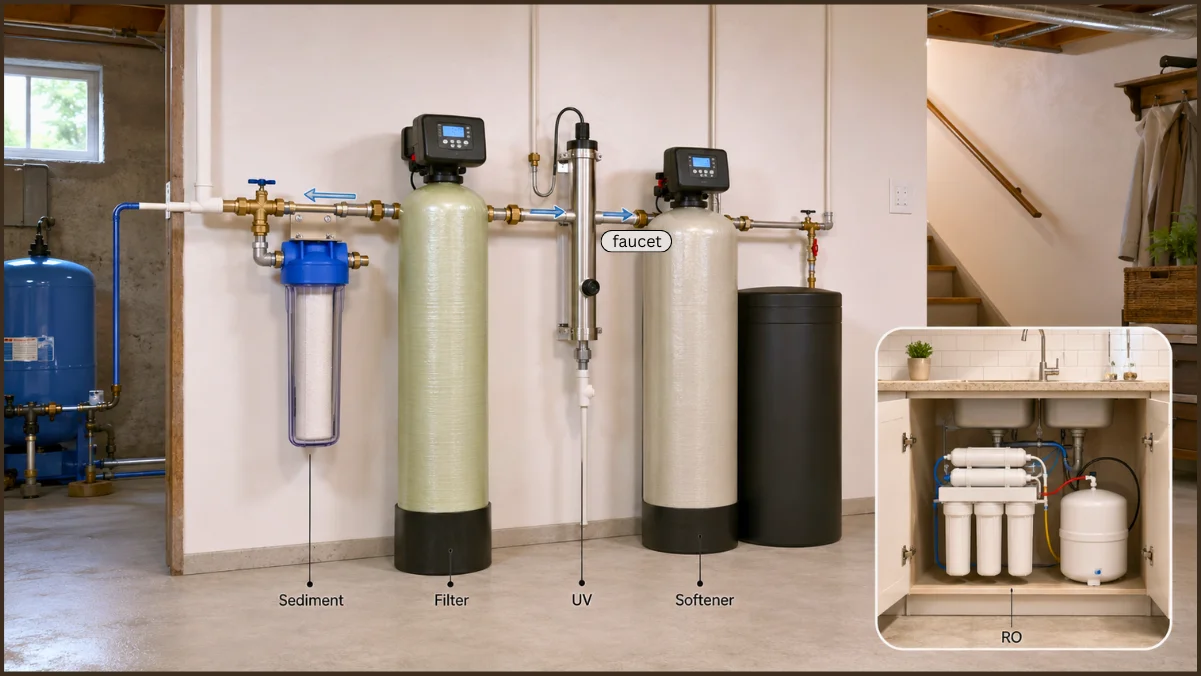
A whole house filter treats water where the main supply enters your home. This is called point-of-entry, or POE, filtration. Because treatment happens before water reaches your fixtures, the system serves showers, washing machines, water heaters, and faucets throughout the house.
For most homes on treated municipal water, I would start with the 3M Aqua-Pure AP904 because it combines high published flow capacity, straightforward cartridge replacement, chlorine taste and odor reduction, sediment filtration, and relatively simple ownership. Private wells need a different approach, and hard water usually needs a softener rather than a standard carbon filter.
Test the water before choosing the treatment system. A filter cannot solve a contaminant problem it was never designed or certified to address.
Quick Answer: Best Whole House Water Filtration System for Most Homes
For most municipal-water homes, choose the 3M Aqua-Pure AP904.
For private well water where UV treatment belongs in the treatment train, the Aquasana Rhino WH-WELL-CT-UV is the stronger fit in this group.
If chlorine taste and odor are the main concerns and minimizing cartridge changes matters, the AO Smith AO-WH-Filter is the low-maintenance option.
For hard water, the Aquasure 64,000 Grain Bundle makes more sense because it combines ion-exchange softening with a point-of-use reverse osmosis system. A conventional whole house carbon filter does not remove calcium and magnesium hardness the way a softener does.
Best House Water Filters: Quick Picks
| Award | Product | Best Fit | Connection Size | Dimensions |
|---|---|---|---|---|
| Best overall for municipal water taste and sediment | 3M Aqua-Pure AP904 | City-water homes that need strong flow and simple cartridge changes | 1 in. NPT | 22.31 in. H × 4.69 in. W; depth not published on current product page |
| Best for well water with UV support | Aquasana Rhino WH-WELL-CT-UV | Private wells needing broader treatment plus UV | 1 in. with Pro-Grade bypass kit | Main tank: 57 in. H × 11 in. dia. |
| Best low-maintenance city-water filter | AO Smith AO-WH-Filter | Treated municipal water with chlorine taste and odor | 3/4 in. supplied plumbing hardware | 29 × 9 × 9 in. |
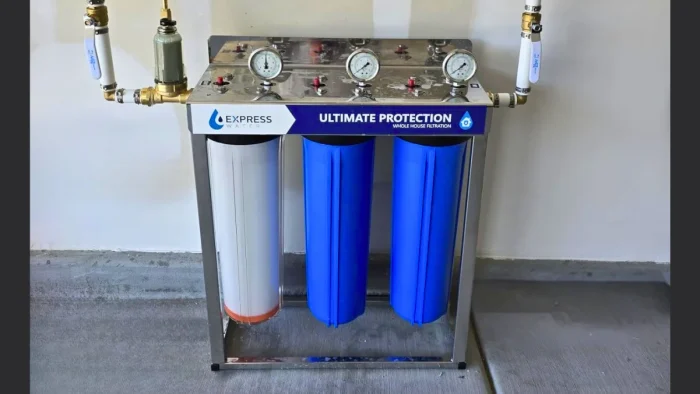
| Best multi-stage cartridge system | Express Water Whole House Water Filter System | Buyers who want three serviceable stages | 1 in. | 29.25 × 23.5 × 8.5 in. |
| Best for iron and manganese | iSpring WGB32BM | Well water with confirmed iron or manganese | 1 in. NPT | 28 × 24.5 × 8 in. |
| Best heavy-duty 3-stage system | PRO+AQUA Elite Series GEN2 PRO-100-E | Buyers who want large cartridges and pressure gauges | 1 in. | Approx. 27 × 23 × 8 in. |
| Best entry-level DIY filter | GE GXWH20T | Basic sediment filtration and prefiltration | 3/4 in. | 4.5 in. H × 13.75 in. D; width not published |
| Best filter + softener + RO bundle | Aquasure 64,000 Grain Bundle | Hard-water homes that also want RO drinking water | System-dependent | 64K softener: approx. 60 in. H × 12 in. tank dia. |
A large gallon rating does not automatically make one filter better. Tank systems usually reduce routine cartridge changes, while cartridge systems provide more control over individual filtration stages. Space, flow restriction, maintenance frequency, and contaminant fit matter just as much.
Comparison: Whole House Filter, Water Pressure, and Best-Fit Buyer
| Product | Water Source | Main Use | Flow / Capacity Snapshot | Connection | Best-Fit Buyer |
|---|---|---|---|---|---|
| 3M Aqua-Pure AP904 | City water | Sediment, chlorine taste/odor, scale inhibition | Up to 20 GPM published by Solventum; 100,000 gal | 1 in. NPT | Homeowner prioritizing high flow and quick cartridge changes |
| Aquasana Rhino WH-WELL-CT-UV | Well water | Carbon/KDF treatment plus UV | 500,000 gal; 14.7 GPM peak for base unit | 1 in. with Pro-Grade bypass kit | Well-water homeowner who needs UV in the treatment train |
| AO Smith AO-WH-Filter | City water | Chlorine taste and odor | 600,000 gal; 7 GPM rated service flow | 3/4 in. supplied hardware | City-water home prioritizing infrequent media service |
| Express Water Whole House System | City or well, depending on cartridge set | Three-stage cartridge filtration | 0.25 gal/sec, or 15 GPM | 1 in. | Buyer who wants independently serviceable stages |
| iSpring WGB32BM | Well/problem water | Sediment, chlorine, iron and manganese | Up to 15 GPM | 1 in. NPT | Home with confirmed iron or manganese |
| PRO+AQUA PRO-100-E | City or well, depending on treatment need | Heavy-duty 3-stage filtration | Up to 15 GPM published maximum | 1 in. | Buyer who wants pressure gauges and larger housings |
| GE GXWH20T | City/light sediment | Basic cartridge filtration | 12 GPM; 16,000 gal; 3-month nominal filter interval | 3/4 in. | Budget buyer with modest sediment concerns |
| Aquasure 64,000 Grain Bundle | Hard water | Softening plus RO drinking water | 64,000-grain softener; 75 GPD RO | System-dependent | Larger household treating hardness and drinking water separately |
The published AP904 specifications list a 100,000-gallon capacity and up to 20 GPM, while iSpring publishes a 15 GPM peak rating with 1-inch NPT connections for the WGB32BM. Aquasana lists 500,000 gallons, a 14.7 GPM peak flow for the Rhino base unit, and a 1-inch Pro-Grade bypass installation kit.
Flow ratings alone do not show the full hydraulic effect. A filter can have an acceptable published maximum flow and create noticeable pressure loss when cartridges load with sediment, fittings are undersized, or several fixtures run simultaneously.
Our Top Picks
 —
Detailed product reviews
3M Aqua-Pure AP904 — Best Overall for Municipal Water Taste and Sediment
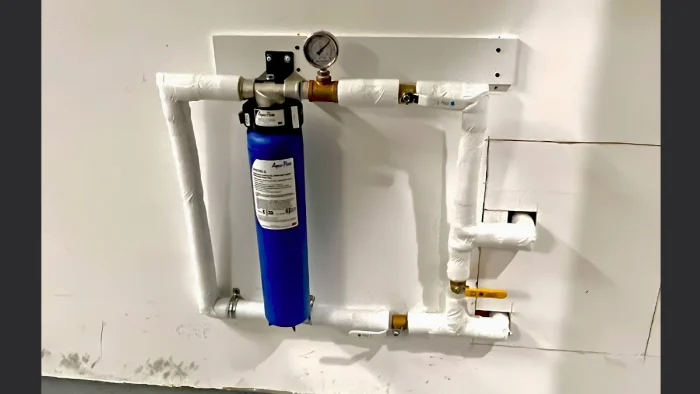
The 3M Aqua-Pure AP904 is the strongest general-purpose city-water choice in this group because its design keeps the ownership side relatively simple while supporting higher household flow.
It uses a Sanitary Quick Change cartridge rather than a conventional reusable sump. That makes cartridge service cleaner and avoids opening a large housing full of water every time the filter reaches the end of its useful life.
Solventum currently publishes a 100,000-gallon capacity, 5-micron rating, and up to 20 GPM flow rate for the AP904. Those numbers make it easier to fit into a home where showers, laundry, and faucets may operate at the same time.
Treatment scope is the main constraint. Do not read “whole house filter” as “removes every contaminant.” The AP904 is better suited to treated municipal water where sediment, chlorine taste and odor, and scale-control support are the relevant concerns. It should not be selected blindly for unsafe well water, iron, bacteria, arsenic, nitrate, PFAS, or hardness.
Who it’s for: City-water homes that want whole-house taste, odor, sediment, and scale support without a large multi-tank treatment system.
Who should skip: Homes with an untreated well or a confirmed contaminant requiring another treatment technology.
Pros:
- High published flow capacity
- Sanitary quick-change cartridge
- 5-micron sediment rating
- Simple ownership compared with multi-stage housings
Cons:
- Narrower treatment scope
- Replacement cartridge required
- Not a water softener
Verdict: The AP904 gets the top spot because it balances flow, maintenance, and a realistic municipal-water treatment role rather than trying to be a universal filter.
Aquasana Rhino WH-WELL-CT-UV — Best Whole House Water Filter for Well Water
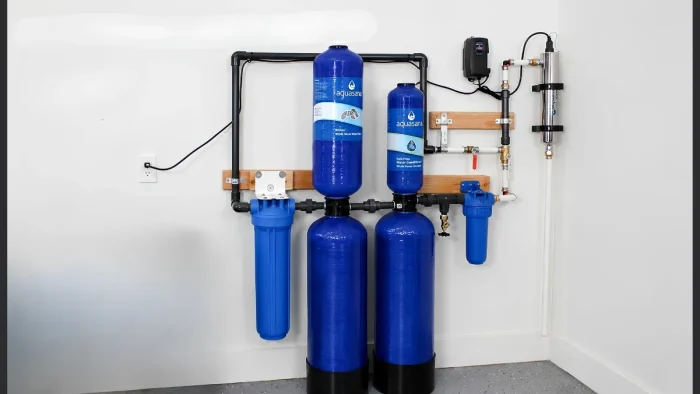
The Aquasana Rhino WH-WELL-CT-UV belongs in a different category from a basic municipal-water carbon filter. Its broader treatment train, particularly the UV stage, is what gives it a clear role on private wells.
Private wells are not managed by a municipal treatment plant. A proper water test can uncover sediment, iron, manganese, hardness, hydrogen sulfide, bacteria, nitrates, arsenic, or pH issues that cannot be diagnosed from taste and smell alone.
Aquasana publishes a 500,000-gallon / five-year capacity for the base well-water Rhino and a 14.7 GPM peak flow rate. The main tank is about 57 inches high and 11 inches in diameter.
The water needs adequate pretreatment before it reaches the UV stage. Sediment, iron, and turbidity, or cloudiness, can interfere with UV transmission. Therefore, check the UV unit’s water-quality requirements and make sure the filtration stages ahead of it meet them.
The Rhino still cannot address every well-water condition. UV does not soften water or remove total dissolved solids, nitrate, arsenic, or every chemical contaminant. Treatment should follow the water-test result.
Who it’s for: Well-water homeowners whose treatment plan calls for whole-house filtration plus UV.
Who should skip: City-water households that only want chlorine taste and odor reduction, or wells requiring specialized iron, sulfur, arsenic, nitrate, or pH treatment beyond this configuration.
Pros:
- Better fit for private wells
- UV treatment component
- Long-life main media tank
- Higher-flow tank configuration
Cons:
- Requires more installation space
- UV needs electrical power
- Pretreatment still matters
- Not a conventional water softener
Verdict: Choose the Rhino when the well-water treatment plan genuinely benefits from its broader filtration and UV architecture.
AO Smith AO-WH-Filter — Best Low-Maintenance City-Water Filter
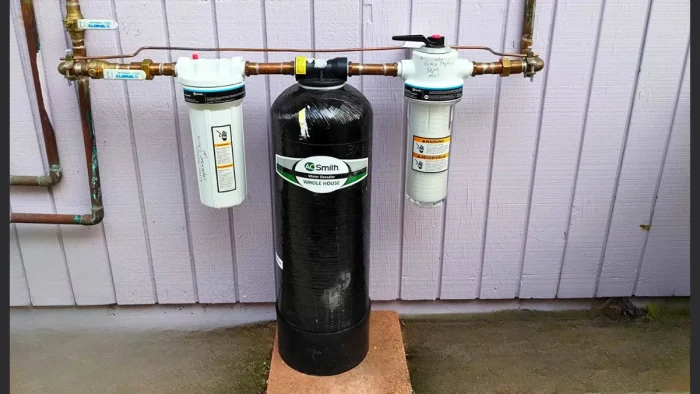
The AO Smith AO-WH-Filter is a much simpler proposition: it is designed primarily for homes that want long-life chlorine taste and odor reduction without changing conventional cartridges every few months.
Unlike a carbon-block cartridge housing, the AO-WH-Filter uses granular activated carbon (GAC) in a tank configuration. A.O. Smith lists the tank at 29 inches high by 9 inches wide by 9 inches deep, with a 7 GPM rated service flow and 600,000-gallon capacity.
The supplied installation hardware includes a shut-off valve, nipple, and hose adapter. The owner's documentation lists 3/4-inch shut-off and nipple components. Check those plumbing details before buying because the 3/4-inch interface and 7 GPM service rating may matter more in a high-demand home than the 600,000-gallon headline.
A.O. Smith's current performance documentation goes further than vague “tested to” language: the system is tested and certified by NSF International against NSF/ANSI Standard 42 for chlorine taste and odor reduction, and the current NSF listing shows AO-WH-FILTER with chlorine, taste, and odor reduction claims.
Its narrow focus is also the main reason to rule it out for some homes. This is not a water softener, RO system, iron filter, or universal health-contaminant treatment system.
Who it’s for: Municipal-water homes where chlorine taste and odor are the main problems and infrequent routine service matters.
Who should skip: Homes with hardness, bacteria, iron, sulfur, nitrate, arsenic, high TDS, or other confirmed conditions that require targeted treatment.
Pros:
- Long rated media capacity
- Granular activated carbon
- Compact tank footprint
- NSF/ANSI 42 certification for specified claims
Cons:
- 7 GPM rated service flow
- Narrow treatment objective
- Not intended as a general well-water solution
Verdict: The AO-WH-Filter is attractive because of its long-life GAC design, but the 7 GPM rating deserves as much attention as the 600,000-gallon capacity.
Express Water Whole House Water Filter System — Best Multi-Stage Cartridge System
The Express Water system gives you control over three independently serviceable filtration stages. You can treat different jobs in sequence rather than replacing one large media tank.
The exact cartridge package matters. Express Water sells several three-stage configurations, so sediment, activated carbon, anti-scale, iron/manganese, and other media should not be treated as interchangeable versions of the same performance claim.
For its standard three-stage configuration, Express Water publishes 1-inch connections, three pressure gauges, dimensions of about 29.25 × 23.5 × 8.5 inches, and a production rate of 0.25 gallon per second — 15 GPM.
Water passes through three housings and three cartridges in sequence, so each stage contributes some resistance. At a given flow rate, total system pressure loss can be thought of as:
ΔPtotal = ΔPstage 1 + ΔPstage 2 + ΔPstage 3 + ΔPfittings
However, this formula does not tell you the exact PSI drop without a pressure-versus-flow curve or measured readings. During ownership, watch how the gauge readings change under similar flow conditions. As the cartridges collect sediment and other material, resistance rises and pressure after the filter can fall. This makes the trend more useful than a single reading.
Express Water's three gauges are particularly useful here because they give you a way to identify where restriction is developing instead of waiting until shower pressure becomes obviously weak.
You also need enough clearance below the housings to remove them during cartridge changes. A tightly packed mechanical room can make a perfectly good filter frustrating to maintain.
Who it’s for: Homeowners who want a configurable cartridge system and are willing to monitor and replace filters as needed.
Who should skip: Buyers who prioritize the lowest possible maintenance burden over cartridge-level control.
Pros:
- Three independently serviceable stages
- Three pressure gauges
- 1-inch connections
- Up to 15 GPM published flow
Cons:
- More cartridges to maintain
- Three stages add hydraulic resistance
- Treatment depends on exact cartridge set
Verdict: Express Water gives you more treatment flexibility and better maintenance visibility, but that flexibility comes with more service work.
iSpring WGB32BM — Best for Iron and Manganese
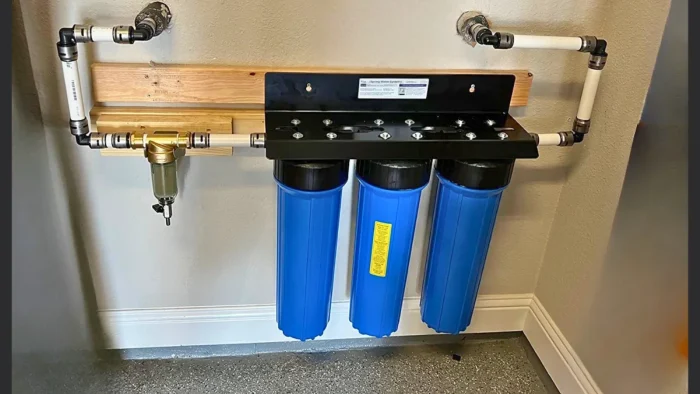
Iron and manganese require a more targeted approach than a general carbon filter, which is why the iSpring WGB32BM has a specific role in this lineup.
The three-stage system combines sediment filtration, carbon filtration, and catalytic media intended for iron and manganese reduction. iSpring publishes 1-inch NPT connections, a peak flow rate of 15 GPM, 20 × 4.5-inch cartridges, and dimensions of approximately 28 × 24.5 × 8 inches.
Water chemistry sets the limit here. iSpring specifies maximum inlet concentrations for its iron and manganese performance, and cartridge life can change significantly as contaminant loading increases. Severe iron, iron bacteria, low pH, hydrogen sulfide, or high sediment may call for a different treatment design.
A cartridge becoming restrictive is not automatically a product defect. If it is collecting a significant contaminant load, pressure loss will increase as the media reaches the end of its useful service period.
Who it’s for: Homes where testing confirms iron or manganese within the system's treatment range.
Who should skip: Buyers guessing at a well-water problem without a laboratory water test.
Pros:
- Targets iron and manganese
- 1-inch NPT connections
- 15 GPM peak rating
- Large 20-inch cartridges
Cons:
- Must match water chemistry
- Cartridge life varies with loading
- Does not replace UV or softening
Verdict: Pick the WGB32BM for a confirmed iron or manganese problem, not simply because the home uses well water.
PRO+AQUA Elite Series GEN2 PRO-100-E — Best Heavy-Duty 3-Stage System
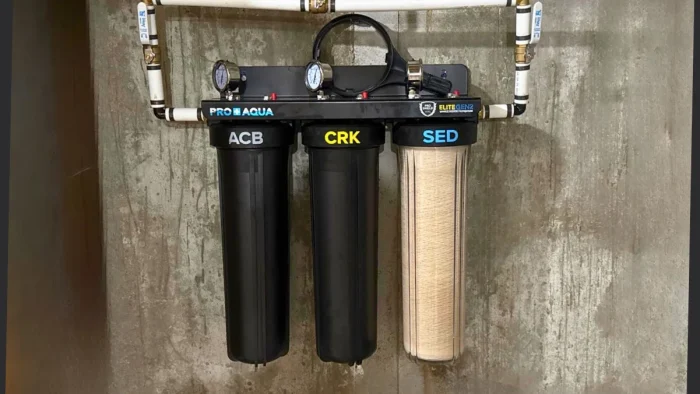
The PRO+AQUA PRO-100-E is another three-stage cartridge system, but its maintenance hardware is what separates it from a basic set of housings.
The unit includes three pressure gauges, pressure-release buttons, large housings, and 1-inch ports. PRO+AQUA lists the system at about 27 inches high, 23 inches wide, and 8 inches deep, with a maximum published flow rate of 15 GPM.
Those gauges give you a direct way to see where restriction is building. A cartridge system becomes progressively more restrictive as filters load, so stage-by-stage pressure readings are more useful than waiting for weak shower flow.
The system needs substantial wall space and service clearance. Three large housings require room below them, and broad contaminant-reduction marketing should always be narrowed to the exact installed cartridge and any applicable test or certification documentation.
Who it’s for: Buyers who specifically want a substantial three-stage cartridge platform with pressure monitoring.
Who should skip: Anyone who needs a certified claim for one particular health contaminant and has not verified that claim for the exact filter set.
Pros:
- Integrated pressure gauges
- Large three-stage housings
- 1-inch ports
- Good maintenance visibility
Cons:
- Requires significant wall space
- Multiple cartridges to service
- Broad claims need exact-model checking
Verdict: PRO+AQUA is a practical choice when maintenance visibility matters as much as filtration stage count.
GE GXWH20T — Best Entry-Level DIY Whole House Filter
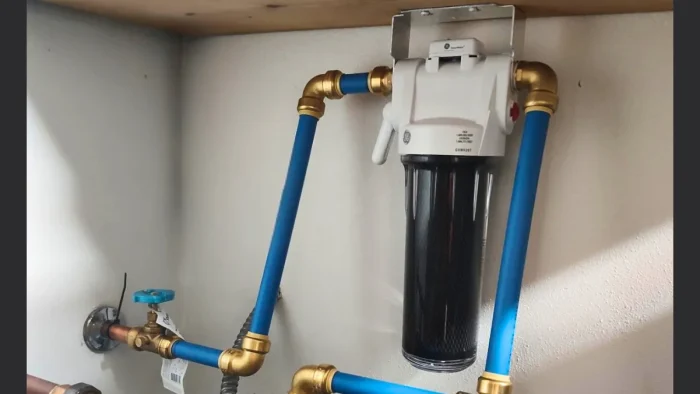
The GE GXWH20T is the simplest product here, and that is its advantage. It is fundamentally a single-housing platform for basic whole-house cartridge filtration. What it removes depends on which compatible cartridge is installed, so the housing itself should not be treated as a complete contaminant-removal system.
GE lists 3/4-inch plumbing connections, a 12 GPM maximum filtered-water flow, a 16,000-gallon capacity, a three-position bypass valve, and a nominal three-month filter interval.
That makes it useful as an affordable sediment filter or prefilter ahead of downstream equipment. The 3/4-inch connection is also worth noticing if the home has a 1-inch main and high simultaneous demand. A smaller local connection does not automatically create an unacceptable pressure problem, but it becomes one part of the total hydraulic resistance.
Who it’s for: Homes needing basic sediment reduction or a simple prefiltration stage.
Who should skip: Anyone treating bacteria, arsenic, nitrate, PFAS, iron, hardness, or another specific contaminant without an appropriate cartridge or treatment system.
Pros:
- Affordable entry point
- 12 GPM published maximum flow
- Built-in bypass option
- Useful as a sediment prefilter
Cons:
- Limited treatment scope
- Frequent cartridge service
- 3/4-inch connections
Verdict: The GXWH20T is useful when you treat it as a simple cartridge housing rather than a universal whole-house purification system.
Aquasure 64,000 Grain Bundle — Best Filter + Softener + Reverse Osmosis Bundle
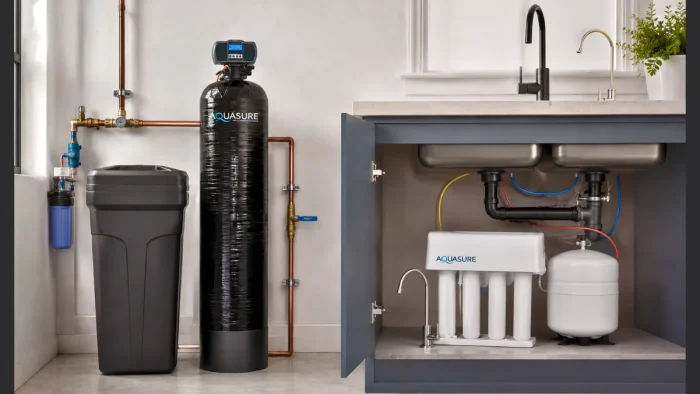
The Aquasure bundle solves a different problem from the carbon and sediment filters above.
If white scale, hard-water spotting, soap performance, and mineral buildup are the real issues, a conventional whole-house carbon filter is the wrong tool. Hardness is primarily a calcium and magnesium problem, which is why an ion-exchange softener belongs here.
The current AS-PR75HS64D bundle combines a 64,000-grain Harmony Series softener with a 75 GPD reverse osmosis drinking-water system. Aquasure positions it for homes with roughly 4–6 bathrooms and up to eight people.
Aquasure's technical documentation shows the 64,000-grain softener tank at approximately 60 inches overall height with a 12-inch-diameter mineral tank. That does not include the full floor area needed for the brine tank, RO equipment, plumbing, drain routing, and future service.
Here, the softener and RO system handle separate jobs. The softener addresses hardness across the home while the RO unit treats drinking water at a specific tap. The extra complexity comes from salt use plus RO filter and membrane maintenance.
Who it’s for: Hard-water households that also want point-of-use RO drinking water.
Who should skip: Homes that only need chlorine taste, odor, or sediment reduction.
Pros:
- Proper hard-water treatment
- Includes 75 GPD RO system
- Suits larger households
- Separates softening from drinking-water filtration
Cons:
- Large installation footprint
- Requires salt
- More components to maintain
Verdict: Choose Aquasure when hardness is the real whole-house problem and RO drinking water is also part of the plan.
Final Verdict: Which Whole House System Should You Choose?
For treated city water with sediment and chlorine taste or odor concerns, the 3M Aqua-Pure AP904 offers the best overall balance in this lineup. Its high published flow rate and quick-change cartridge make it a practical starting point. However, scale inhibition should not be confused with water softening.
The AO Smith AO-WH-Filter is worth considering if fewer routine filter changes matter more to you. Check its 7 GPM rated service flow first, though. A large gallon capacity does not tell you whether it can comfortably serve several fixtures at once.
For private wells, let the water-test results lead. The Aquasana Rhino WH-WELL-CT-UV fits a treatment plan that needs filtration plus UV, provided the incoming water meets the UV stage’s requirements. If testing identifies iron or manganese instead, the iSpring WGB32BM is the more targeted option within its specified treatment limits. Neither system is a complete answer to every well-water problem.
Prefer separately replaceable cartridges? Compare Express Water and PRO+AQUA PRO-100-E around the exact filter set, service clearance, and replacement costs. For basic sediment filtration or prefiltration, the simpler GE GXWH20T may be enough.
Finally, if hardness is causing scale and mineral buildup, the Aquasure 64,000 Grain Bundle addresses a different need: whole-house softening alongside RO drinking-water treatment. Choose it because you need those two jobs done, rather than because it includes more equipment.
The strongest choice is the system that treats your confirmed water problem, supports your household’s demand, and stays manageable to maintain.
Compare the products
Choose the products you want to compare. Ratings retain each product’s original rubric.
| Product | 3M Aqua-Pure AP904 — Best Overall for Municipal Water Taste and Sediment | Aquasana Rhino WH-WELL-CT-UV — Best Whole House Water Filter for Well Water | AO Smith AO-WH-Filter — Best Low-Maintenance City-Water Filter | Express Water Whole House Water Filter System — Best Multi-Stage Cartridge System | iSpring WGB32BM — Best for Iron and Manganese | PRO+AQUA Elite Series GEN2 PRO-100-E — Best Heavy-Duty 3-Stage System | GE GXWH20T — Best Entry-Level DIY Whole House Filter | Aquasure 64,000 Grain Bundle — Best Filter + Softener + Reverse Osmosis Bundle |
|---|
Whole House Filter vs. RO vs. Water Softener
These systems solve different problems, although a home may need more than one.
A whole house filter treats water before it reaches fixtures throughout the building. Depending on its media, it may reduce sediment, chlorine taste and odor, or specific contaminants. However, ordinary sediment and carbon filters do not remove hardness minerals the way a softener does.
An ion-exchange water softener removes calcium and magnesium. By comparison, a salt free water conditioner is designed to reduce scale formation while leaving those minerals in the water. Conditioning therefore differs from softening. Check the conditioner’s water-chemistry limits before choosing it for scale control.
Point of use filters treat water where you drink or cook with it. Examples include faucet-mounted filters, under-sink filters, and countertop systems. If the concern is limited to drinking water, a filter certified for that contaminant may be more practical than treating every gallon entering the house.
Reverse osmosis uses a membrane to reduce dissolved substances that standard sediment and carbon filtration may leave behind. It is commonly used at a dedicated drinking-water tap. Meanwhile, UV treatment addresses microorganisms under suitable water-quality and installation conditions.
Choose each technology for its specific job. One does not automatically replace the others.
Plumbing Sizing Decision Rule
Pipe size is a useful first screening tool, but it is not a substitute for calculating household demand and checking the filter's pressure-drop data.
| Main Water Line | Practical Starting Point | What to Verify |
|---|---|---|
| 3/4 in. | Roughly 10–12 GPM-capable filter | Peak simultaneous fixture demand and pressure loss |
| 1 in. | Roughly 15–20 GPM-capable filter | Prefer full-size ports and adequately sized media or cartridges |
| 1-1/4 in. or larger | High-flow tank or engineered manifold | Size from actual design demand rather than a residential rule of thumb |
These are screening ranges, not plumbing-code limits.
A 3/4-inch-port filter on a 1-inch main creates a local reduction in flow area. Whether that restriction becomes noticeable depends on the flow being demanded, the filter media, fittings, cartridge condition, available supply pressure, and the rest of the plumbing system.
The GE GXWH20T is a useful example: GE specifies 3/4-inch plumbing connections but also publishes a maximum filtered-water flow of 12 GPM. That can be perfectly reasonable in a modest-demand home while being less attractive for a large house where several high-flow fixtures operate simultaneously.
What to Look for in a Whole House Filter
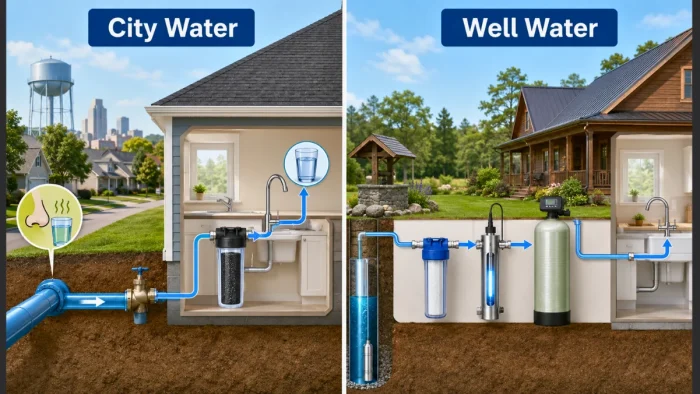
The right house filtration system depends on five main factors:
- Water source
- Actual contaminants
- Peak flow requirement
- Installation space and pipe size
- Maintenance tolerance
Match the System to the Water Source
For city water, start with your utility’s annual water quality report, also called a Consumer Confidence Report. It shows which contaminants were detected in the public supply. However, it does not replace testing at your tap when household plumbing or a specific local concern may affect the water.
Private wells need a different approach because the homeowner is responsible for treatment. Laboratory water testing helps identify bacteria, nitrate, iron, manganese, hardness, and other problems that taste or smell cannot reliably reveal. EPA recommends annual well testing for total coliform bacteria, nitrates, total dissolved solids, and pH. Depending on local conditions, additional tests may be needed.
Match the Filter to the Contaminant
| Water Problem | Better Treatment Starting Point |
|---|---|
| Chlorine taste or odor | Activated carbon |
| Chloramine | Catalytic carbon or specifically verified treatment |
| Sand, rust, silt | Sediment filtration |
| Iron or manganese | Targeted iron/manganese treatment |
| Hydrogen sulfide | Specialized sulfur treatment or oxidation |
| Microbiological concern | Properly designed UV or other disinfection |
| Hard water | Ion-exchange water softener |
| High TDS | Reverse osmosis for drinking water |
| Fluoride or nitrate | Appropriately certified RO or other targeted technology |
| Drinking-water-specific contaminant | Certified point-of-use treatment may be more practical |
Whole-house filtration is useful when the problem affects showers, laundry, appliances, plumbing, or water throughout the building. A point-of-use system can be more efficient when the concern is limited to drinking water.
Watch the Micron Rating
Finer filtration is not automatically better.
| Micron Rating | Typical Use | Trade-Off |
|---|---|---|
| 50–100 micron | Sand and coarse grit | Does not capture fine sediment |
| 10–20 micron | Rust, dirt, visible sediment | Moderate restriction |
| 5 micron | Fine sediment and prefiltration | Can load faster |
| 1 micron | Very fine particles | Higher pressure-drop risk |
A fine sediment cartridge can clog quickly when well water carries heavy dirt or grit. Instead, a sediment pre-filter can catch larger particles before water reaches finer filters and other treatment equipment. This staged approach reduces the sediment load farther along the system.
Pretreatment also matters before UV disinfection. Suspended particles can interfere with UV light reaching microorganisms, so follow the UV manufacturer’s incoming-water requirements. A sediment pre-filter helps prepare the water; it does not replace disinfection.
Verify Certifications and Material Safety
Certification wording matters.
“Certified to NSF/ANSI” is not the same as “tested to,” “tested against,” “designed to meet,” or “uses a certified component.”
| Claim | What It Establishes |
|---|---|
| Certified to NSF/ANSI X | The listed product or component has third-party certification for defined claims under that standard |
| Certified component | The specified component is certified; the claim does not automatically extend to every part of the assembled system |
| Tested to / tested against NSF/ANSI X | Testing may have used the standard, but the wording alone does not prove a current certification listing |
| Designed to meet NSF/ANSI X | A design or manufacturer claim, not certification |
Common standards include:
| Standard | Typical Scope |
|---|---|
| NSF/ANSI 42 | Aesthetic effects including chlorine taste and odor |
| NSF/ANSI 53 | Specific health-effect contaminant reduction claims |
| NSF/ANSI 55 | Ultraviolet microbiological water treatment |
| NSF/ANSI 58 | Reverse osmosis systems |
| NSF/ANSI/CAN 61 | Health effects of drinking-water system materials and components |
Do not treat the number alone as proof that a filter removes every contaminant within that category. The exact model and reduction claim matter.
The AO Smith AO-WH-Filter provides a good example: its current documentation and NSF listing support certification under NSF/ANSI 42 for chlorine, taste, and odor reduction. That is a much narrower and more useful statement than simply saying “NSF certified.”
When health-related treatment drives the purchase, check the exact model in the NSF, WQA, or IAPMO public directory before relying on a marketing claim.
Check Flow Rate and Water Pressure
Flow rate is measured in gallons per minute, or GPM. It tells you how much water passes through the filter under the stated conditions. Water pressure, usually measured in PSI, is different: it describes the pressure available to move that water through your plumbing.
Also check whether the manufacturer lists a rated service flow or a peak flow. These figures describe different operating conditions, so they should not be treated as interchangeable. Compare the filter’s ratings with the demand from fixtures that may run together, such as a shower, washing machine, and kitchen faucet.
A rough household screening guide is:
| Home Demand | Practical Flow Target |
|---|---|
| 1–2 bathrooms | 7–10 GPM |
| 2–3 bathrooms | 10–12 GPM |
| 3+ bathrooms | 12–15+ GPM |
| Larger or high-demand home | 15–20 GPM |
The filter also needs to maintain usable pressure while those fixtures are running. For example, a suitable maximum flow rating does not guarantee strong shower pressure once a cartridge becomes clogged.
As sediment builds up, resistance can increase and pressure after the filter can fall. Therefore, check pressure-drop data where available and monitor changes during use. Gauges on systems such as Express Water and PRO+AQUA help you track pressure rather than relying only on how the shower feels.
Compare Maintenance and Replacement Costs
Purchase price is only one part of whole-house filtration cost.
| Cost Area | Ownership Impact |
|---|---|
| Sediment cartridges | Usually inexpensive, but dirty water can shorten life |
| Carbon cartridges | Recurring replacement cost |
| Three-stage systems | More treatment control, but several cartridges to replace |
| Large media tanks | Higher upfront cost with less frequent media service |
| UV | Requires electrical power and lamp maintenance |
| Water softener | Requires salt and periodic servicing |
| Reverse osmosis | Filters and membrane eventually need replacement |
| Professional installation | Higher upfront cost but may reduce plumbing mistakes |
Filter-life ratings are estimates, not guaranteed replacement intervals. For example, a sediment cartridge may need changing sooner when incoming water carries heavy dirt or rust. Carbon-filter life also depends on water use and contaminant loading.
Therefore, compare replacement-filter costs alongside the purchase price. Follow the manufacturer’s service schedule and watch for pressure changes, leaks, or other maintenance signs. A long main-tank rating does not remove the need to service separate pre-filters, UV components, or other equipment.
Installation Checklist: Space, Access, and Plumbing
Before buying, check:
- Main water-line diameter
- Available installation height and width
- Clearance below cartridge housings
- Bypass-valve requirements
- Drain requirements
- Electrical supply for UV or controls
- Shut-off locations
- Direction of water flow
- Water-softener placement
- Pressure limits
- Access for future service
Cutting into a main water line is different from installing a faucet filter. Copper, PEX, galvanized pipe, pressure tanks, well pumps, grounding continuity, and confined mechanical rooms can all increase installation complexity.
Use a qualified plumber when the plumbing work exceeds your competence or when local code, electrical bonding, pressure control, or well equipment makes the installation more involved.
Common Buyer Mistakes With Whole House Filtration Systems
Buying by Stage Count:
Three stages are not automatically better than one.
A three-stage system containing the wrong cartridges for your water is still the wrong system. Match the treatment mechanism to the contaminant rather than counting housings.
Ignoring Water Pressure:
A filter can meet its advertised flow rating and still be a poor match for a high-demand home.
Consider port size, cartridge size, pressure-drop data where available, and simultaneous fixture demand.
Confusing Filtration With Softening:
Carbon does not remove hardness minerals the way an ion-exchange softener does.
If scale is the main problem, compare the treatment options before spending money on a carbon-only filter.
Expecting Carbon to Remove TDS:
Standard carbon filtration is not a substitute for reverse osmosis when dissolved-solids reduction is the objective.
Skipping Water Testing:
This is the mistake that causes most mismatched treatment purchases.
Taste, smell, staining, and cloudy water can point you toward a problem, but they do not reliably identify every contaminant or its concentration.
Editorial Transparency
This guide combines engineering analysis, exact-model manufacturer specifications, current certification information where verified, practical ownership considerations, and editorial judgment.
Manufacturer-rated flow, capacity, contaminant reduction, and certification claims are kept separate from Wits Engineer observations.
No instrument-measured pressure-drop, micron pass-through, housing-torque, or laboratory-style bench results are presented unless those measurements were actually recorded.
— Engr. Hm Jamal, Ruly Jathra.
How We Chose These Whole House Water Filters
A whole house filter has to match the actual water problem. Stage count by itself tells you very little.
Municipal water may call for chlorine, chloramine, taste, odor, sediment, or specific chemical reduction. Private wells can introduce iron, manganese, sediment, hydrogen sulfide, bacteria, hardness, nitrates, arsenic, pH problems, and other conditions that may require several different treatment technologies.
I compared these systems around:
- Water-source fit
- Contaminant match
- Flow capacity
- Pressure-drop risk
- Filter or media service life
- Installation requirements
- Plumbing size
- Maintenance burden
- Replacement-filter access
- System footprint
- Applicable certification claims
- Overall buyer fit
A manufacturer rating remains a specification, not a Wits Engineer test result. Where exact pressure-drop or contaminant-performance measurements were not recorded, I do not present invented bench data.
Why Trust Wits Engineer
Wits Engineer evaluates filtration through the buying and ownership problems that matter in a real plumbing system: What is in the water? How much peak flow does the home need? What happens as the filter loads? How much room is needed to service it? Does the certification apply to the entire system, one component, or only a particular reduction claim?
Those questions matter more than a long feature list.
Engr. Hm Jamal
Founder & Lead Technical EditorFounder of Wits Engineer, with a practical background in electrical and water systems. His product reviews focus on setup, performance, maintenance and the trade-offs that affect everyday ownership.