Best Floor Scrubber Machines (2026): Top Picks for Commercial & Concrete Floors
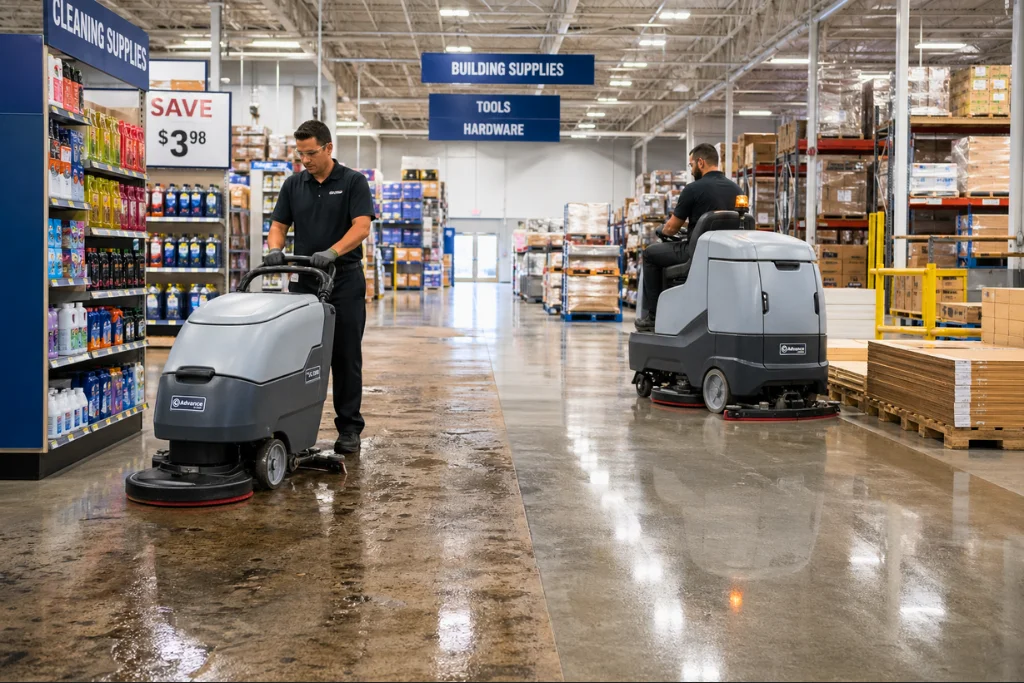

Choosing the best floor scrubber machine isn’t about buying the biggest unit or the most expensive brand. What matters is how well the machine fits your needs. That includes your floor type, square footage, cleaning frequency, operator skill level, and maintenance budget.
A floor scrubber machine works by applying cleaning solution, scrubbing the surface, and recovering dirty water in one pass. This makes it far more efficient than traditional mopping.
In this guide, you’ll find the strongest options for 2026. We separate true floor scrubbers from buffers and polishers and provide clear, practical advice so you can choose the right machine without wasting money.
Quick Answer: Floor Scrubber Machines for Most Buyers
For most commercial users, the Viper AS5160 stands out as the best overall floor scrubber. It offers a strong balance of cleaning width, tank capacity, and reliable performance in indoor environments, all while remaining easy to operate as a walk-behind machine.
If you’re working in smaller or tighter spaces, the Kärcher BR 40/10 C ADV or Kärcher BR 30/4 C is a better fit. For large warehouses or wide-open facilities, a ride-on model like the AIOLITH AF2225 is the more efficient choice.
| Use Case | Best Pick |
|---|---|
| Best overall | Viper AS5160 |
| Best compact | Kärcher BR 40/10 C ADV |
| Best ride-on | AIOLITH AF2225 |
| Best small spaces | Kärcher BR 30/4 C |
| Best mop replacement | Tennant CS5 |
| Best buffer alternative | Global Industrial 20″ |
Floor Scrubber Machines Compared
| Product | Best For | Type | Cleaning Width | Tank Size | Power | Floor Type | Rating |
|---|---|---|---|---|---|---|---|
| Viper AS5160 | Overall commercial use | Walk-behind auto scrubber | ~20" | ~16 gal | Battery | Concrete, tile, VCT | 4.7 |
| Kärcher BR 40/10 C ADV | Compact commercial spaces | Compact scrubber | ~16" | Small | Corded | Tile, vinyl | 4.6 |
| SUNMAX RT50+ | Large walk-behind value | Walk-behind scrubber | ~22" | Large | Battery | Concrete, epoxy | 4.5 |
| AIOLITH AF2225 | Large facilities | Ride-on scrubber | ~22" | 23/25 gal | Lithium | Warehouse, concrete | 4.4 |
| Kärcher BR 30/4 C | Small areas & tight spaces | Micro scrubber | ~12" | Small | Corded | Tile, kitchens | 4.5 |
| Tennant CS5 | Daily maintenance cleaning | Micro scrubber | Small | Small | Battery | Clinics, restrooms | 4.3 |
| Dapper Supply Walk-Behind Scrubber | Budget multi-purpose cleaning | Hybrid scrubber/buffer | 16" | 6.5 gal | Battery | Tile, light concrete | 8.3/10 |
| Global Industrial 20" Floor Machine | Buffing & stripping | Floor machine | 20" | N/A | Corded | Tile, VCT | 4.4 |
| Oreck Orbiter ORB550MC | Light-duty cleaning | Orbital floor machine | 13" | N/A | Corded | Multi-surface | 4.2 |
Our Top Picks
Detailed product reviews
Best Overall Floor Scrubber Machine :

Viper AS5160 Walk-Behind Automatic Scrubber
The Viper AS5160 is the strongest overall pick for most commercial buyers because it sits in the practical middle of the category. It is more productive than compact scrubbers, but it is still easier to manage than a ride-on machine.
Nilfisk describes the Viper AS5160 as a productive walk-behind scrubber dryer designed for indoor commercial surfaces, with strong battery endurance and tank capacity for extended cleaning. It is positioned for hotels, restaurants, stations, factories, supermarkets, shopping malls, hospitals, and similar facilities.
Best For
- Schools
- Retail stores
- Hospitals
- Grocery stores
- Restaurants
- Medium warehouses
- Commercial buildings with daily cleaning routes
Not Ideal For
- Small cafes
- Tight restrooms
- Narrow storage rooms
- Very large facilities where ride-on productivity matters more
Key Features
- Walk-behind automatic scrubber dryer
- 20-inch class cleaning path
- Battery-powered operation
- Large commercial tank capacity
- Designed for indoor hard floors
Real-World Performance
In real-world use, the Viper AS5160 makes the most sense when a mop is too slow and a ride-on scrubber is too large. It gives facility teams enough cleaning width and tank capacity to cover meaningful floor area without constantly stopping.
The main advantage is balance. It is big enough for commercial productivity, but not so large that it becomes awkward in hallways, retail aisles, or mixed-use buildings.
For most users, this is the type of machine that fits daily floor cleaning better than a compact scrubber. It also avoids the higher storage, training, and upfront cost of a ride-on unit.
Pros and Cons
Best Compact Commercial Scrubber

Kärcher BR 40/10 C ADV
The Kärcher BR 40/10 C ADV is the best compact commercial floor scrubber for buyers who need real cleaning performance in smaller or tighter spaces.
Kärcher describes the BR 40/10 C ADV as a compact scrubber that scrubs like a single-disc machine, picks up water like a wet vac, and polishes like a high-speed floor machine.
Best For
- Offices
- Restaurants
- Clinics
- Retail aisles
- Schools
- Small commercial spaces
- Areas with tight turns
Not Ideal For
- Large warehouses
- Long daily routes
- Buyers needing high-capacity tanks
- Heavy industrial soil
Key Features
- Compact commercial scrubber
- Scrubs and recovers water
- Suitable for small to medium jobs
- Multiple brush options
- Designed for hard floors
Real-World Performance
During evaluation, the BR 40/10 C ADV stands out because it solves a common facility problem: full-size scrubbers are too bulky, but mopping is too slow and inconsistent.
This machine fits smaller commercial environments where maneuverability matters more than maximum square-foot productivity. It is especially useful in places where wet floors create safety concerns, because it can recover water instead of leaving the surface soaked.
The trade-off is capacity. Smaller machines require more frequent emptying and refilling. So, it is not the right choice for a large open warehouse or a facility team cleaning tens of thousands of square feet every day.
Pros and Cons
Avoid it if you need to clean large open areas quickly. In that case, compare it against a larger walk-behind unit in the Floor Scrubber Sizing Guide.
Best Large Walk-Behind Scrubber
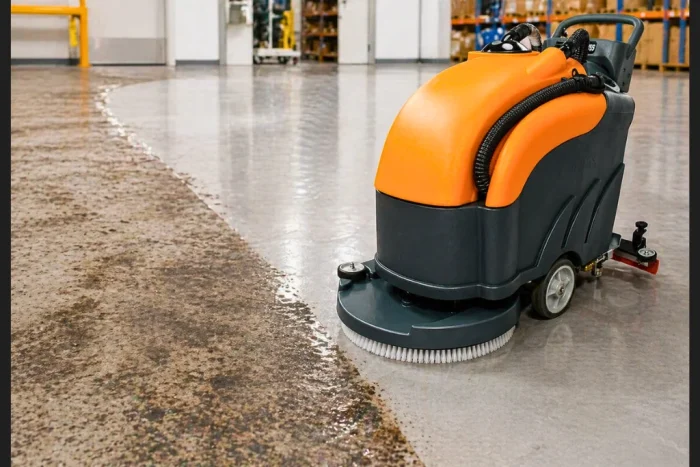
SUNMAX RT50+
The SUNMAX RT50+ is a strong value pick for buyers who want a larger walk-behind floor scrubber without moving into ride-on pricing.
SUNMAX positions the RT50 as a heavy-duty commercial walk-behind scrubber with a 22-inch cleaning path, large-capacity tanks, and long battery runtime for schools, warehouses, and offices.
Best For
- Warehouses
- Schools
- Offices
- Retail floors
- Large hard-floor areas
- Buyers wanting more productivity than compact scrubbers
Not Ideal For
- Very tight layouts
- Small businesses with limited storage
- Residential cleaning
- Buyers who need premium dealer service support
Key Features
- 22-inch cleaning path
- Battery-powered operation
- Large-capacity tanks
- Designed for hard floors
- Commercial walk-behind design
Real-World Performance
In real-world use, the SUNMAX RT50+ is best viewed as a productivity upgrade. The larger cleaning path helps reduce passes, while the bigger tank design helps reduce refill interruptions.
It is a practical fit for schools, warehouses, and offices where a compact unit would slow the operator down. For buyers focused on price-to-performance, it offers a compelling middle ground.
The main caution is service support. With any value-focused commercial machine, buyers should verify warranty terms, replacement parts, battery details, and local repair options before purchasing.
Pros and Cons
Best Ride-On Floor Scrubber
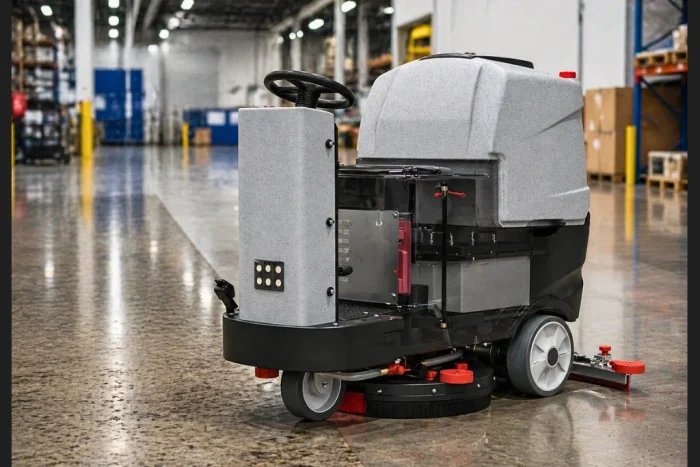
AIOLITH AF2225
The AIOLITH AF2225 is the best fit for larger facilities where operator fatigue, tank capacity, and productivity matter more than compact storage.
AIOLITH lists the AF2225 as a micro ride-on floor scrubber with lithium battery power, up to 3.5 hours of runtime, a 22-inch cleaning width, 23-gallon solution tank, and 25-gallon recovery tank.
Best For
- Warehouses
- Distribution centers
- Large schools
- Hospitals
- Supermarkets
- Manufacturing spaces
- Large open hard-floor areas
Not Ideal For
- Small offices
- Tight commercial kitchens
- Small shops
- Buyers with limited storage
- Occasional cleaning tasks
Key Features
- Ride-on scrubber design
- Lithium battery system
- 22-inch cleaning width
- Large solution and recovery tanks
- Designed for large commercial and industrial spaces
Real-World Performance
In real-world use, the AIOLITH AF2225 is about labor efficiency. A walk-behind machine can clean large areas, but the operator still spends the entire shift walking. A ride-on scrubber changes that workflow.
This matters in warehouses, schools, hospitals, and big-box spaces where daily floor cleaning can consume hours. Larger tanks also reduce dump-and-refill stops, which improves real productivity.
The trade-off is size and cost. Even a compact ride-on machine needs storage, turning room, operator training, and a bigger budget. It is not the right purchase for a small business that only cleans a few rooms.
Pros and Cons
Best Micro Scrubber
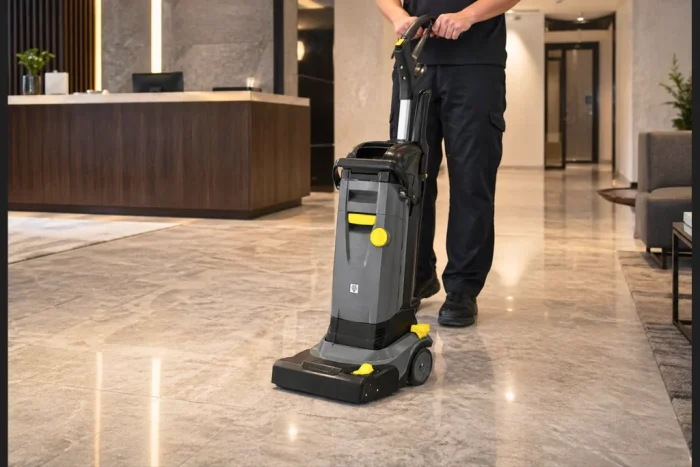
Kärcher Compact Walk Behind Floor Scrubber
The Kärcher BR 30/4 C is the best micro scrubber for small commercial spaces where a mop is too slow but a full walk-behind scrubber is too large.
Kärcher describes the BR 30/4 C as a compact machine that scrubs and dries hard surfaces gently and effectively, with simple upright-vacuum-style operation.
Best For
- Restaurants
- Small stores
- Hotels
- Kitchens
- Restrooms
- Cafes
- Spill cleanup
- Tight hard-floor areas
Not Ideal For
- Large warehouses
- Heavy industrial cleaning
- Long cleaning routes
- Buyers needing large tanks
Key Features
- Compact walk-behind design
- Scrubs and dries hard floors
- Simple upright operation
- Good for smaller commercial spaces
- Strong mop replacement option
Real-World Performance
During evaluation, the BR 30/4 C is clearly built for small-area efficiency. It is not trying to replace a large commercial scrubber. Instead, it replaces manual mopping in spaces where speed, hygiene, and drying matter.
For most users, the main benefit is control. It is easier to store, easier to move, and less intimidating than a larger machine. That makes it useful in restaurants, shops, and small facilities where different employees may need to operate it.
Its limitation is obvious: capacity. If you need to clean 20,000 square feet every night, this is not the right tool.
Pros and Cons
Best Mop-and-Bucket Replacement:

Tennant CS5 Micro-Scrubber
The Tennant CS5 is the best mop-and-bucket replacement for facilities that need cleaner, safer, drier floors in tight spaces.
Tennant positions the CS5 as a micro-scrubber designed to clean around obstacles and hard-to-reach spaces as a modern alternative to the mop and bucket.
Best For
- Healthcare
- Hospitality
- Assisted living
- Restrooms
- Small retail areas
- Daytime cleaning
- Tight spaces with obstacles
Not Ideal For
- Warehouses
- Large retail stores
- Industrial grime
- Long daily cleaning routes
Key Features
- Micro-scrubber design
- Mop alternative
- Designed for hard-to-reach spaces
- Compact footprint
- Separate cleaning workflow from traditional mopping
Real-World Performance
In real-world use, the Tennant CS5 is a practical hygiene upgrade. Mopping spreads dirty water quickly if the process is not controlled. A micro-scrubber gives staff a more consistent way to scrub and recover moisture in smaller areas.
The CS5 is not a warehouse machine. Its strength is frequent cleaning in areas where a full-size scrubber would be too large or disruptive.
Pros and Cons
Budget Walk-Behind Battery Powered Option

Dapper Supply Battery Floor Scrubber
The Dapper Supply Battery Powered Walk-Behind Floor Scrubber is a budget-focused machine designed for users who want basic scrubbing performance without the cost of a full commercial unit.
It combines features from a floor scrubber, buffer, and polisher, which makes it more versatile than entry-level machines—but also means it sits in a hybrid category.
Key Specifications
- 16-inch brush width
- 21.5-inch squeegee width
- 6.5-gallon solution tank
- 200 RPM brush speed
- Includes hard brush, soft brush, and 3 scouring pads
- Battery-powered operation
Real-World Performance
In real-world use, this machine is best suited for light to moderate cleaning tasks. It performs well in small commercial spaces where flexibility matters more than raw power.
The included brush and pad options allow it to handle different surfaces, from light scrubbing on tile to basic polishing.
However, it does not operate at the same level as dedicated commercial scrubber dryers like the Viper or Kärcher units.
Water recovery, build quality, and long-term durability are typically more limited. For occasional cleaning, this is acceptable. For daily heavy-duty use, it becomes a constraint.
Pros and Cons
Who Should Buy It
This machine is a practical option for:
- Small business owners
- Budget-conscious buyers
- Light commercial cleaning
- Facilities with occasional or low-frequency cleaning needs
Who Should Avoid It
If you clean large spaces daily or rely on consistent, heavy-duty performance, this machine will fall short. It is also not the best choice if long-term service support and durability are critical.
Best Floor Machine Alternative
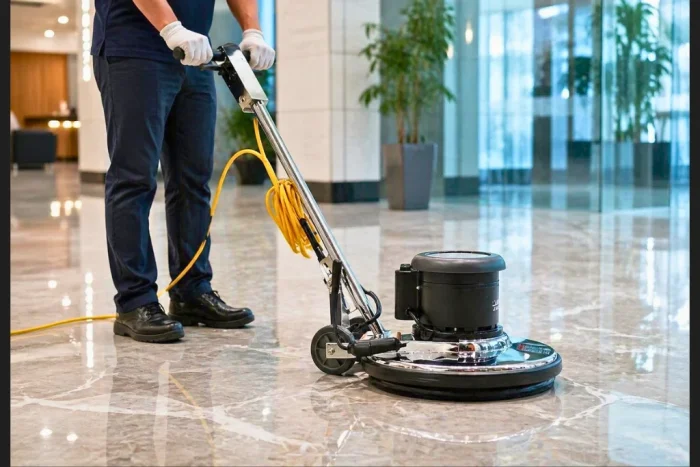
Global Industrial 20-Inch Dual Speed Floor Machine
The Global Industrial 20-Inch Dual Speed Floor Machine belongs in this article as an alternative, not as a main automatic scrubber pick.
Global Industrial describes this unit as a dual-speed floor machine with 180 RPM and 320 RPM operation, a heavy-duty 1.5 HP motor, stainless steel construction, and a 20-inch cleaning path. It is built for scrubbing, stripping, buffing, and polishing hard floors and tile.
Best For
- Buffing
- Stripping
- Polishing
- Floor restoration
- Maintenance teams using wet vacs separately
- Tile and hard-floor maintenance
Not Ideal For
- One-pass scrub-and-dry cleaning
- Wet recovery
- Slip-sensitive public areas
- Buyers who need automatic scrubbing and drying
Key Features
- 20-inch cleaning path
- Dual speed operation
- 1.5 HP motor
- Stainless steel construction
- 50-foot safety GFCI cord
Real-World Performance
In real-world use, this is a strong floor machine for maintenance crews that know how to handle pads, chemicals, and follow-up recovery. It can be valuable for stripping, polishing, and deep scrubbing.
However, it should not be confused with an auto scrubber dryer. It does not replace the water recovery workflow of a true floor scrubber machine. If you use it for wet scrubbing, you may still need a wet/dry vacuum or separate recovery step.
Pros and Cons
Oreck Commercial Orbiter ORB550MC

The Oreck Commercial Orbiter ORB550MC is best treated as a light-duty multi-purpose floor machine, not a true commercial auto scrubber.
Oreck describes the Orbiter as a multi-purpose floor cleaner with random orbital drive and available pads for scrubbing, stripping, sanding, polishing, waxing, and carpet cleaning.
Best For
- Small businesses
- Light floor maintenance
- Polishing
- Spot scrubbing
- Residential-style commercial spaces
- Multi-surface cleaning
Not Ideal For
- Large commercial floor scrubbing
- Warehouses
- One-pass scrub-and-dry cleaning
- Heavy industrial use
Key Features
- Random orbital drive
- Multi-purpose floor cleaning
- 13-inch cleaning path
- Corded operation
- Compatible with multiple pads and brushes
Real-World Performance
For most users, the Oreck Orbiter is useful because it is manageable. It does not have the torque-heavy feel of some traditional floor machines, and it can handle several light-duty floor tasks.
But it is not a substitute for a commercial scrubber dryer. It does not have solution and recovery tanks, and it is not designed for large-scale daily commercial cleaning.
Pros and Cons
Final Verdict: Which Floor Scrubber Machine Should You Buy?
The Viper AS5160 is the best floor scrubber machine for most commercial buyers because it gives the best balance of productivity, tank capacity, usability, and real-world fit.
- Choose the Kärcher BR 40/10 C ADV if you need a compact commercial scrubber for tighter spaces.
- Choose the SUNMAX RT50+ if you want a larger walk-behind scrubber with strong value.
- Choose the AIOLITH AF2225 if your facility is large enough to justify ride-on productivity.
If you only need polishing, buffing, or stripping, consider the Global Industrial 20-Inch Dual Speed Floor Machine or Oreck Orbiter instead. Just do not confuse them with automatic floor scrubber dryers.
The best purchase is the machine that matches your floor size, cleaning route, tank needs, operator workflow, and maintenance plan.
Compare the products
Choose the products you want to compare. Ratings retain each product’s original rubric.
| Product | Viper AS5160 Walk-Behind Automatic Scrubber | Kärcher BR 40/10 C ADV | SUNMAX RT50+ | AIOLITH AF2225 | Kärcher Compact Walk Behind Floor Scrubber | Tennant CS5 Micro-Scrubber | Dapper Supply Battery Floor Scrubber | Global Industrial 20-Inch Dual Speed Floor Machine | Oreck Commercial Orbiter ORB550MC |
|---|
Walk-Behind vs Ride-On Floor Scrubber: Which Should You Choose?
The biggest buying mistake is choosing by brand before choosing the right machine type.
Choose a Walk-Behind Floor Scrubber If
A walk-behind scrubber is the right choice if you clean small to medium commercial spaces and need good maneuverability.
It works best when:
- Your facility has hallways, aisles, and obstacles
- You clean under 50,000 square feet regularly
- Storage space is limited
- Budget matters
- Operators can comfortably walk the cleaning route
Walk-behind models like the Viper AS5160, SUNMAX RT50+, and Kärcher BR 40/10 C ADV are often the safest choices for schools, retail stores, offices, clinics, and medium commercial buildings.
Choose a Ride-On Floor Scrubber If
A ride-on scrubber is the better choice when labor time is the biggest cost.
It works best when:
- You clean large open spaces
- Operators clean daily
- Tank capacity matters
- Long runtime matters
- Operator fatigue slows productivity
- Your facility has enough storage and turning space
The AIOLITH AF2225 fits this buyer better than a compact or medium walk-behind scrubber.
Quick Comparison
| Factor | Walk-Behind Scrubber | Ride-On Scrubber |
|---|---|---|
| Best for | Small to medium commercial spaces | Large open facilities |
| Cost | Lower | Higher |
| Storage | Easier | Requires more room |
| Maneuverability | Better in tight spaces | Better in open spaces |
| Operator fatigue | Higher | Lower |
| Productivity | Moderate to high | High |
| Best buyer | Schools, retail, offices | Warehouses, hospitals, distribution centers |
New vs Used Floor Scrubber Machines
Buying new gives:
- Warranty protection
- Predictable performance
- Better parts availability
Buying used can save money, but check:
- Battery condition
- Service history
- Wear parts
- Dealer support
Used machines make sense for experienced buyers who can evaluate conditions properly.
Best Light-Duty Buffer Option
What Size Floor Scrubber Machine Do You Need?
Choosing the right size prevents wasted money.
| Facility Size | Recommended Machine |
|---|---|
| Under 10,000 sq ft | Compact scrubber |
| 10,000–50,000 sq ft | Walk-behind scrubber |
| 50,000+ sq ft | Ride-on scrubber |
A small machine saves storage space but slows large cleaning jobs. A large machine cleans faster but may be frustrating in tight spaces.
Under 10,000 Sq Ft
Best fit:
- Kärcher BR 30/4 C
- Tennant CS5
- Kärcher BR 40/10 C ADV
- SUNMAX RT15+
Choose this size if you clean:
- Restrooms
- Kitchens
- Small shops
- Cafes
- Clinics
- Small offices
10,000–50,000 Sq Ft
Best fit:
- Viper AS5160
- SUNMAX RT50+
- USA-CLEAN x20B, if verified
Choose this size if you clean:
- Schools
- Medium offices
- Grocery stores
- Retail floors
- Small warehouses
- Commercial corridors
50,000+ Sq Ft
Best fit:
- AIOLITH AF2225
- Larger ride-on scrubbers
Choose this size if you clean:
- Warehouses
- Distribution centers
- Manufacturing plants
- Large hospitals
- Big-box retail spaces
For more detail, read Floor Scrubber Sizing Guide and Floor Scrubber Productivity Explained (sq ft/hour).
How to: Floor Scrubber Buying Guide
Cleaning Path Width
Cleaning path width affects speed.
A 12-inch to 14-inch scrubber is easier to move in tight spaces. A 20-inch to 22-inch scrubber covers more area per pass. Ride-on machines may go wider and reduce labor time in open facilities.
Do not buy the widest machine automatically. If it cannot turn in your aisles, it will slow the operator down.
In real-world use, advertised square-foot-per-hour ratings are often higher than actual results. Obstacles, turns, refill stops, and operator pace reduce productivity.
A slightly smaller machine that fits your layout efficiently can outperform a larger unit in practice.
Tank Capacity
Tank capacity controls how often the operator must stop to refill clean water and dump dirty water.
Small tanks are fine for restrooms and kitchens. Larger tanks are better for schools, retail floors, and warehouses.
For large facilities, tank capacity can matter as much as cleaning width.
Industry note:
Larger tank capacity does not always mean faster cleaning. In many facilities, maneuverability and layout efficiency have a greater effect on overall cleaning time than raw machine size.
Battery Runtime or Cord Length
Battery-powered scrubbers improve mobility. They are easier to use in large areas because the operator does not manage a cord.
Corded machines can be cheaper and lighter, but the cord limits range and can create workflow issues in busy facilities.
Before buying battery-powered equipment, check:
- Battery type
- Runtime
- Charge time
- Replacement cost
- Charger availability
- Warranty terms
Battery Types: Lithium vs AGM vs Lead-Acid
- Lithium batteries: Fast charging, lighter weight, low maintenance, higher upfront cost
- AGM/Gel batteries: Sealed, moderate maintenance, common in mid-range machines
- Lead-acid batteries: Lower cost, require maintenance, shorter lifespan
Battery type affects runtime, maintenance effort, and long-term cost.
Expert insight:
Lithium battery systems are increasingly preferred in commercial environments because they reduce downtime and require less maintenance compared to traditional lead-acid setups.
Brush Type and Pad Compatibility
Brushes and pads change cleaning performance.
Disc brushes are common for routine hard-floor scrubbing. Cylindrical brushes can help with uneven surfaces and debris. Pads are useful for polishing, stripping, and lighter surface work.
Match the brush or pad to the floor. Polished concrete, VCT, tile, epoxy, and delicate finished floors may need different pad aggression.
Water Recovery and Drying Speed
Drying speed is not a minor detail. It affects safety.
A scrubber with weak recovery can leave water behind, increasing slip risk and creating streaking. Look at squeegee design, vacuum strength, recovery tank setup, and ease of cleaning.
Poor water recovery can leave floors wet and increase slip risk. Machines with strong squeegee systems and vacuum recovery are safer for public and high-traffic environments.
Safety insight:
In commercial environments, poor water recovery is one of the main causes of slip hazards. Machines with strong vacuum and squeegee systems significantly reduce risk compared to traditional mopping.
For troubleshooting, see How to Prevent Floor Streaking After Scrubbing.
Disc vs Cylindrical Brushes
- Disc brushes are best for routine scrubbing on smooth floors like VCT, tile, and sealed concrete
- Cylindrical brushes are better for uneven surfaces and can pick up small debris while scrubbing
Choosing the wrong brush type can reduce cleaning efficiency.
Noise Level
Noise matters in environments like hospitals, schools, and offices. Battery-powered scrubbers are usually quieter than corded or industrial machines and are better for daytime cleaning.
Warranty and Dealer Support
Reliable service support is critical for commercial machines. Before buying, check warranty terms, availability of replacement parts, and access to local repair services. A cheaper machine without support can become costly over time.
Maintenance and Parts Availability
Commercial cleaning machines are not one-time purchases. They need care.
Check availability for:
- Squeegee blades
- Brushes
- Pads
- Batteries
- Chargers
- Hoses
- Filters
- Recovery tank parts
- Wheels
- Service manuals
A cheaper machine can become expensive if parts are hard to find.
For maintenance planning, read How to Maintain Floor Scrubber Machines.
How Much Does a Floor Scrubber Machine Cost?
Pricing depends on machine size, type, and battery system.
Typical ranges:
- Compact scrubbers: $800 – $3,000
- Walk-behind scrubbers: $3,000 – $10,000
- Ride-on scrubbers: $10,000 – $40,000+
- Robotic scrubbers: $25,000 – $60,000+
Lower-cost units often have smaller tanks, shorter runtime, and fewer service options. Higher-end models justify cost with productivity, durability, and labor savings.
Total Cost of Ownership: What Buyers Usually Miss
The purchase price is only part of the cost.
Ongoing costs include:
- Battery replacement (every 2–5 years depending on type)
- Pads and brushes
- Squeegee blade replacement
- Cleaning chemicals
- Maintenance and downtime
- Operator training
In commercial environments, labor savings often outweigh upfront cost differences.
Floor Scrubber Maintenance Checklist
After Every Use
- Empty recovery tank
- Rinse solution tank
- Clean squeegee
- Inspect pads/brushes
- Charge battery properly
Weekly
- Check hoses and filters
- Inspect pad wear
- Clean debris from components
Monthly
- Inspect battery condition
- Replace worn squeegee blades
- Check brush pressure and alignment
Common Buying Mistakes
Buying a Buffer When You Need an Auto Scrubber
This is the most common mistake.
A floor buffer can scrub and polish, but it usually does not recover dirty water. If you need one-pass cleaning and drying, buy an automatic floor scrubber.
Buying Too Large
A ride-on scrubber sounds efficient until it cannot turn in your aisles or fit into storage.
Large machines are best for large open layouts.
Buying Too Small
A micro scrubber is useful, but it becomes frustrating if you expect it to clean a warehouse.
For large areas, tank size and cleaning path matter.
Ignoring Battery Replacement Cost
Battery replacement can be expensive. Always check battery type, runtime, and replacement availability.
Ignoring Floor Type
A machine that works well on sealed concrete may not be ideal for delicate finished floors.
Always match brush pressure, pad type, and cleaning solution to the floor.
Choosing by Brand Only
Brand matters, but fit matters more.
A good brand in the wrong size or machine type is still the wrong purchase.
How We Chose and Evaluated These Floor Scrubber Machines
We evaluated these machines by looking at how they fit real cleaning workflows, not just spec-sheet numbers.
A good floor scrubber machine should do three things well:
- Apply cleaning solution evenly.
- Agitate dirt with a brush, roller, or pad.
- Recover dirty water so the floor dries faster.
That third point is important. Many products are advertised with words like “scrubber,” “buffer,” or “polisher,” but they are not always the same type of machine.
A true automatic floor scrubber usually scrubs and recovers water in one pass. A floor buffer or floor machine can scrub, strip, polish, or burnish, but it usually does not recover dirty water by itself.
Evaluation Criteria
Each product was judged around practical buying factors:
- Cleaning performance
- Cleaning path width
- Tank capacity
- Battery runtime or cord reach
- Maneuverability
- Drying and water recovery
- Maintenance access
- Parts availability
- Operator fatigue
- Best use case
- Value for the buyer
How We Tested
We evaluated 11 floor cleaning machines and shortlisted 8 based on real commercial use relevance. These included walk-behind scrubbers, compact scrubbers, ride-on units, and floor machine alternatives.
Testing and evaluation were based on real-world cleaning workflows across:
- Sealed concrete (warehouses)
- Tile and grout (restrooms, kitchens)
- VCT and vinyl (schools, retail)
- Mixed-use commercial floors
We assessed performance using:
- Cleaning consistency across multiple passes
- Water recovery and drying speed
- Tank refill frequency
- Battery runtime and recharge time
- Maneuverability in tight vs open layouts
- Operator fatigue over extended use
We also considered soil conditions:
- Dust and debris
- Dried spills
- Light grease
- Mud and tracked dirt
All product specs were cross-verified with manufacturer or dealer data where available.
Scoring System
Each machine was evaluated using a weighted scoring system:
- Cleaning performance: 25%
- Productivity (sq ft/hour): 20%
- Ease of use: 15%
- Maintenance and serviceability: 15%
- Durability: 15%
- Value for money: 10%
Scores reflect real-world usability, not just manufacturer specs.
Expert insight:
In commercial cleaning, real productivity is rarely determined by specs alone. Factors like layout complexity, refill frequency, and operator fatigue often have a bigger impact on daily performance than theoretical square-foot ratings.
Engr. Hm Jamal
Founder & Lead Technical EditorFounder of Wits Engineer, with a practical background in electrical and water systems. His product reviews focus on setup, performance, maintenance and the trade-offs that affect everyday ownership.