VonWater V2-800N Review: Fast Flow, but TDS Results Fell Short

In this VonWater V2-800N review, our team measured TDS reduction, filling speed, wastewater, and operating noise. Liter fills took 28.5–31 seconds, and installation needed no additional parts in our setup. The narrow tankless housing was practical, though filtration results gave us more reason to pause.
Its filtration result was less convincing. Across our recorded TDS sessions, feed water measured 54 ppm and stabilized output measured 16 ppm—a calculated 70.4% reduction. That is below VonWater’s stated rejection benchmark, although our records do not establish a controlled replication of the manufacturer’s test conditions.
The V2-800N deserves consideration for fast dispensing and its narrow housing. Our results give us less confidence recommending it primarily for dissolved-solids rejection or for a specific contaminant without further evidence.
Our verdict
Fast Flow, Modest TDS Reduction
| Metric | Weight | Rating | Notes |
|---|---|---|---|
| TDS Reduction | Not supplied | 5.5/10 | Reduced TDS from 54 to 16 ppm—a 70.4% reduction, below the stated benchmark. |
| Dispensing Speed | Not supplied | 9.0/10 | Filled a 1-liter bottle in 28.5–31 seconds, making larger fills convenient. |
| Water Efficiency | Not supplied | 8.0/10 | Achieved a 2:1 pure-to-drain ratio continuously, falling to 1.5:1 during short draws. |
| Installation & Design | Not supplied | 8.5/10 | Narrow housing, 30-minute installation, and no leaks detected through the 24-hour check. |
| Noise | Not supplied | 6.5/10 | Measured 62.5 dBA with the cabinet open; closing the doors reduced noise below 48 dBA. |
| Maintenance & Filter Cost | Not supplied | 7.5/10 | Accessible cartridges simplify handling, but replacement requires flushing; estimated annual filter costs are $79–$158. |
- Liter fills took roughly half a minute
- Continuous dispensing achieved a 2:1 pure-to-drain ratio
- Narrow housing avoids a separate storage tank
- Front access simplified cartridge handling
- Recorded TDS reduction was below the stated benchmark
- First-glass TDS rose after overnight inactivity
- Short draws reduced measured water recovery
- Pump noise was noticeable with the cabinet open
Our VonWater V2-800N Review & Experience
Source overall rating: 7.3/10. The original rubric is retained below; no missing weights were inferred.
Wits Engineer Editorial Rating
Our Measured Results
| Test | Result |
|---|---|
| Feed / stabilized output TDS | 54 / 16 ppm |
| Calculated TDS reduction | 70.4% |
| First 240 mL after overnight inactivity | 42 ppm |
| Recorded purge volume to stabilization | 280–350 mL |
| 240 mL fill trials | 6.0–6.8 seconds |
| 1-liter fill trials | 28.5–31 seconds |
| Continuous dispensing | 2 L filtered / 1 L drained |
| Short-draw sessions | 1.5 L filtered / 1 L drained |
| Noise, cabinet open, at 1 meter | 62.5 dBA |
| Noise, cabinet closed | Below 48 dBA |
| Background noise | 38.0 dBA |
| Installation / initial flushing | 30 minutes / 30 minutes |
| Leak checks | None detected immediately or at 24 hours |
These findings cover one unit, three recorded TDS sessions, and repeated fill trials. Actual feed pressure, temperature, meter calibration, and cumulative filter throughput were not documented in the supplied test record. Consequently, comparisons with rated performance are indicative rather than controlled verification. We did not measure long-term filter life or individual contaminant removal.
Installation and Cabinet Fit
Our installation took about 30 minutes, excluding initial flushing. The supplied kit covered our connections, and the initial and 24-hour inspections found no leaks.
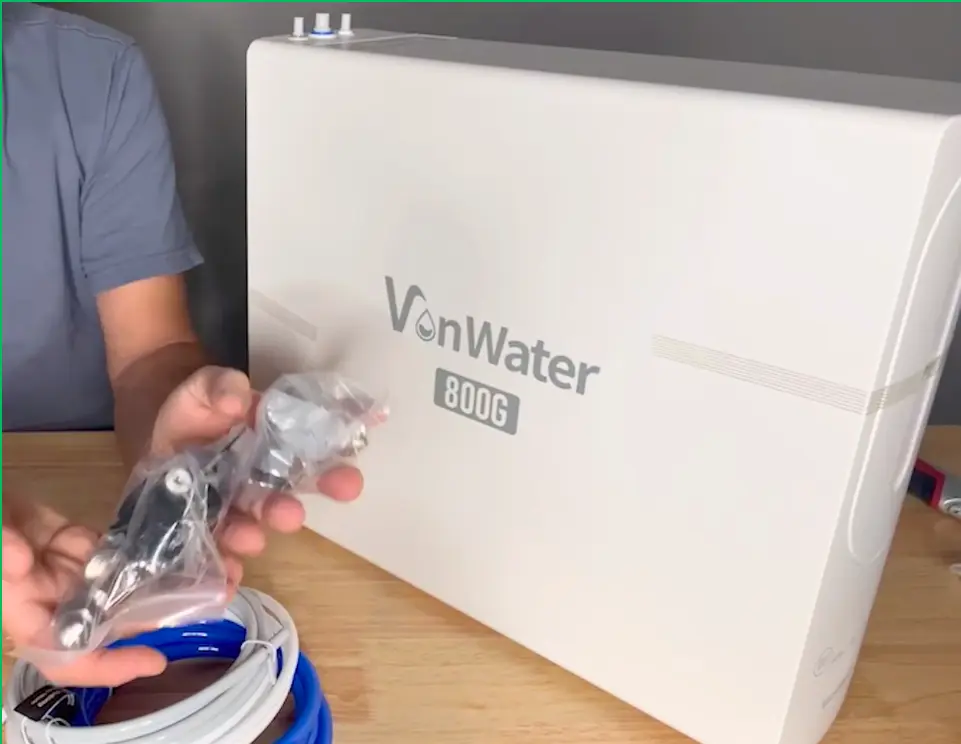
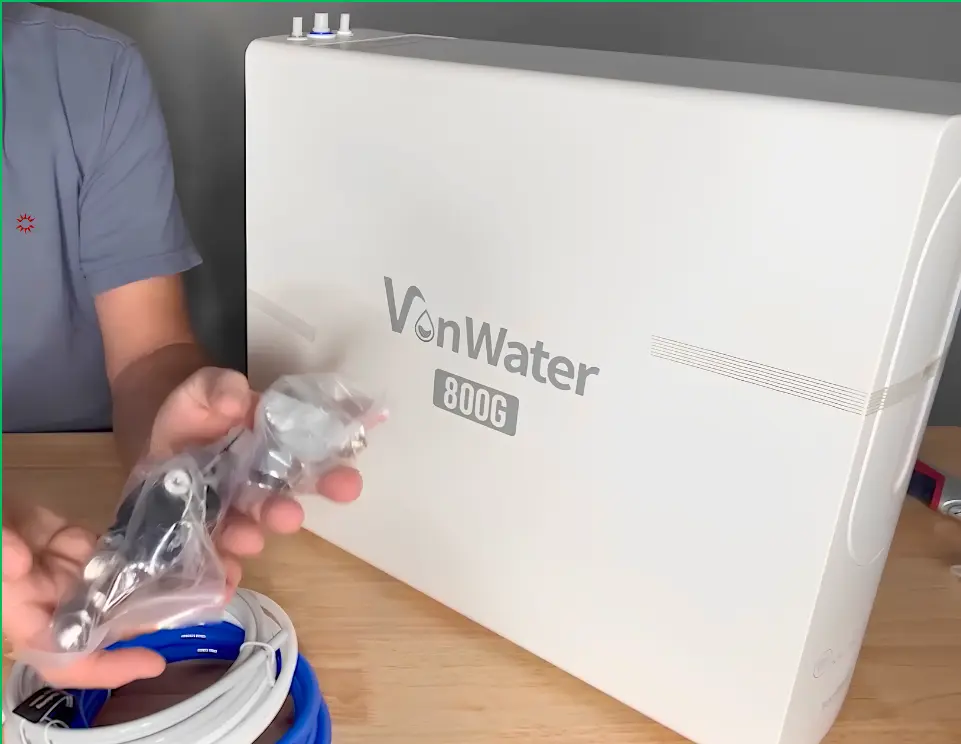 Installation fittings and tubing supplied with the VonWater 800G system.
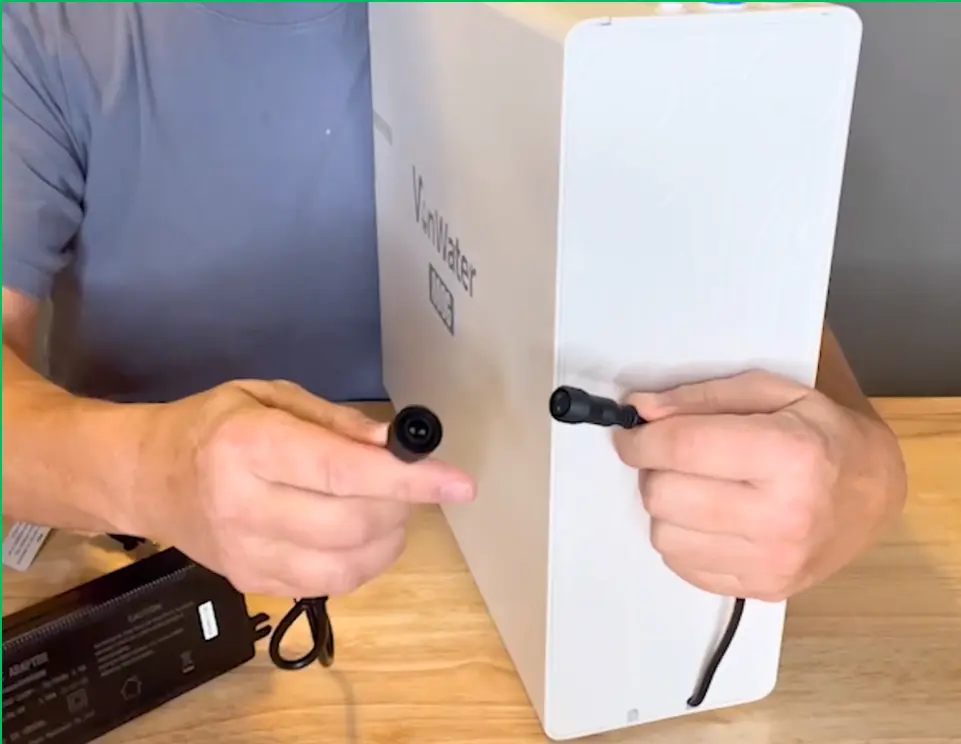 Matching connectors link the external power adapter to the system.
At approximately 13.9 inches high, 4.9 inches wide, and 16.2 inches deep, the housing is narrow enough to make placement easier around existing plumbing. Depth still matters: allow room for tubing bends, the cabinet door, and front cartridge access.
Plan for a cold-water connection, drain connection, RO faucet, and electrical outlet. Countertop drilling depends on whether a suitable spare opening already exists. Our installation time should not be treated as an estimate for a job requiring new countertop work.
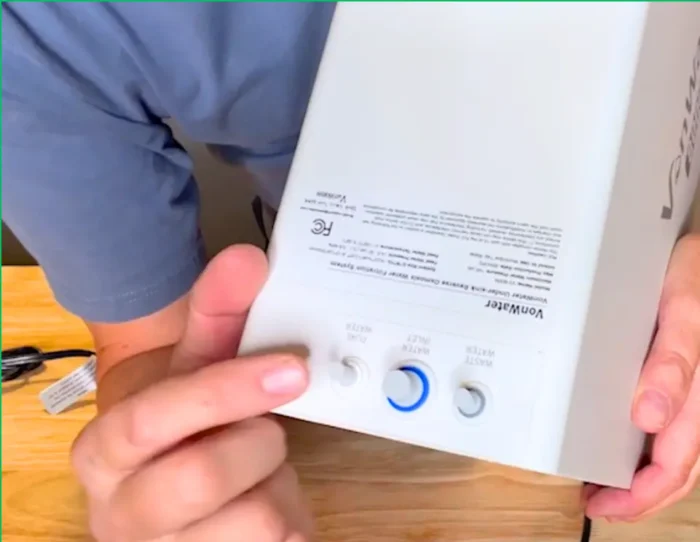
The included tubing clips were installed before leak checks. Those successful checks establish a good initial seal in our installation, rather than long-term leak resistance.
The manual calls for a 30-minute initial flush before drinking. It also specifies a 41–100°F feed-water range and 14.5–87 psi inlet pressure. These are operating limits, not the measured conditions of our tests.
TDS Reduction: 54 ppm Down to 16 ppm
The main filtration finding was a 38 ppm reduction, equivalent to 70.4%. VonWater’s manual specifies greater than 90% rejection under standard laboratory conditions.
Our result fell below that figure. Because the test conditions were not fully recorded, it does not establish a formal failure against the rating. It does establish that our reported measurements did not demonstrate the advertised rejection performance.
A final reading of 16 ppm may sound reassuring, particularly when the feed was already low in dissolved solids. However, output TDS alone cannot show whether lead, arsenic, PFAS, or another particular contaminant was reduced.
For a buyer seeking substantially lower TDS, this is the result to scrutinize before purchase. Higher advertised capacity and additional filtration stages do not resolve the gap.
First-Glass Water After Overnight Inactivity
The first 240 mL after sitting overnight measured 42 ppm, compared with 16 ppm once output stabilized. Morning use therefore differed meaningfully from continuous dispensing.
Our recorded purge volume was approximately 280–350 mL before reaching the stabilized reading. The notes do not distinguish whether that volume included the initial sampled glass, so it should not be treated as an exact total discard requirement.
The practical finding remains useful: an immediate first glass did not deliver the same TDS reading as water collected after running the faucet. A lower stabilized reading should not be presented as the result for every serving.
Filling Speed: About Half a Minute per Liter
The liter-bottle trials were the clearest dispensing result. Filling took 28.5–31 seconds, equivalent to approximately 1.94–2.11 L/min.
That is close to the manufacturer’s listed 2.1 L/min flow at the faster end. It makes the V2-800N convenient for drinking bottles and cooking containers without a storage tank.
The 240 mL trials took 6.0–6.8 seconds, implying 2.12–2.40 L/min. Since that range exceeds the bottle-derived flow, we give the longer measurement greater weight when assessing dispensing speed. The short trials remain observations, rather than proof of above-rated sustained output.
The 800 GPD rating is a daily production specification. Our timed fills assess faucet delivery; they do not independently verify full-day production.
Wastewater and Recovery
Continuous dispensing produced 2 liters of filtered water for each liter drained, matching the advertised 2:1 ratio. That equals 66.7% recovery during the collection period.
Short-draw sessions produced 1.5 liters filtered per liter drained, or 60% recovery. On those figures, each liter delivered generated about 0.67 liters of drain water, compared with 0.5 liters during continuous dispensing.
These are recovery measurements, rather than percentages saved against another system. They also exclude any unmeasured water deliberately discarded from the faucet while waiting for TDS to stabilize.
The useful ownership lesson is that repeated small servings were less efficient in our recorded sessions. A single steady-flow ratio would miss that difference.
Noise During Use
With the cabinet open, operating noise reached 62.5 dBA at 1 meter against a 38.0 dBA background. Closing the doors brought the recorded level below 48 dBA.
The enclosure made a substantial difference in our setup. Buyers placing the system in an open cabinet should pay more attention to pump noise than those using a fully enclosed space.
Our notes did not identify physical rattling. Leave clearance between the housing and cabinet walls to reduce vibration transfer. Cabinet construction and placement can change the result, so these measurements should not be treated as universal noise specifications.
Filter Replacement, Cost, and Warranty
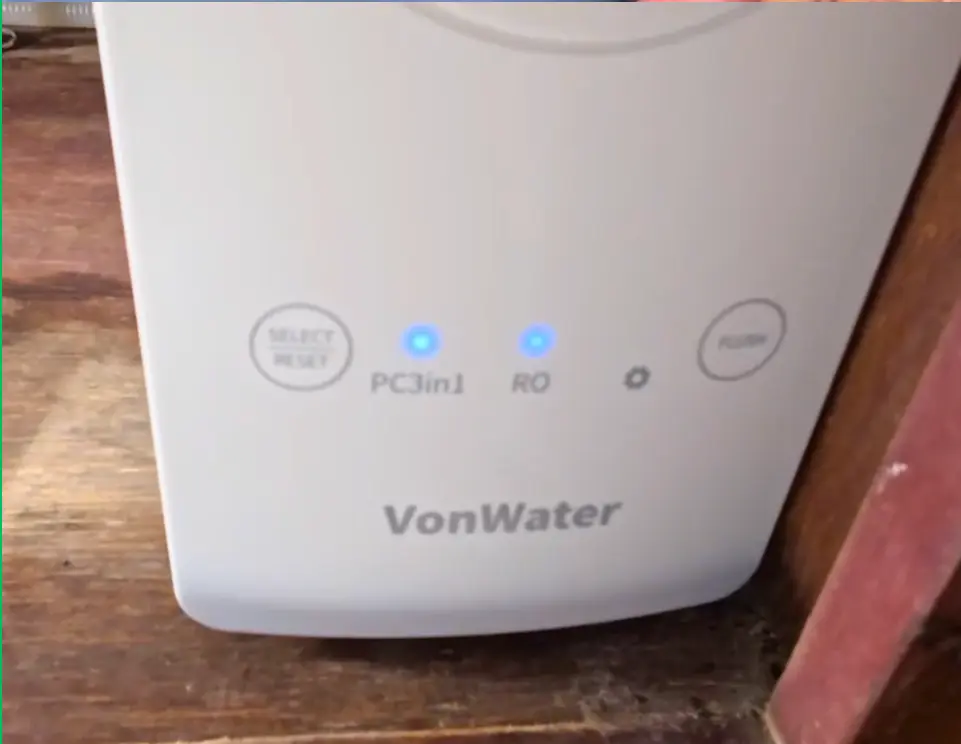 Front-panel controls provide filter selection, indicator reset, and manual flushing.
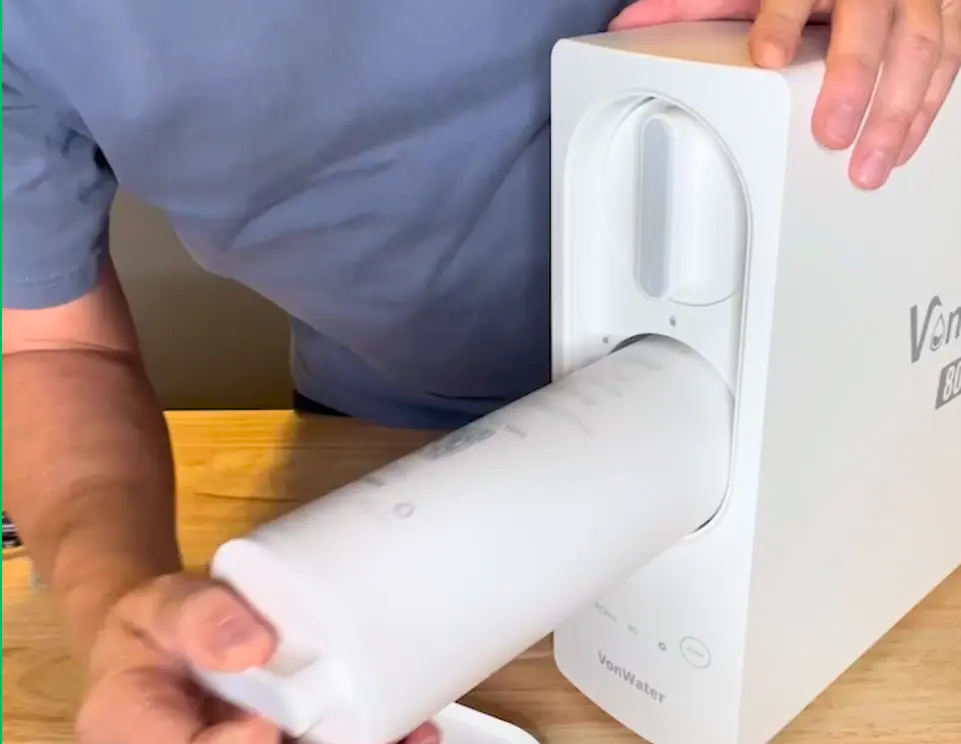 The RO membrane cartridge slides out through the lower front compartment.
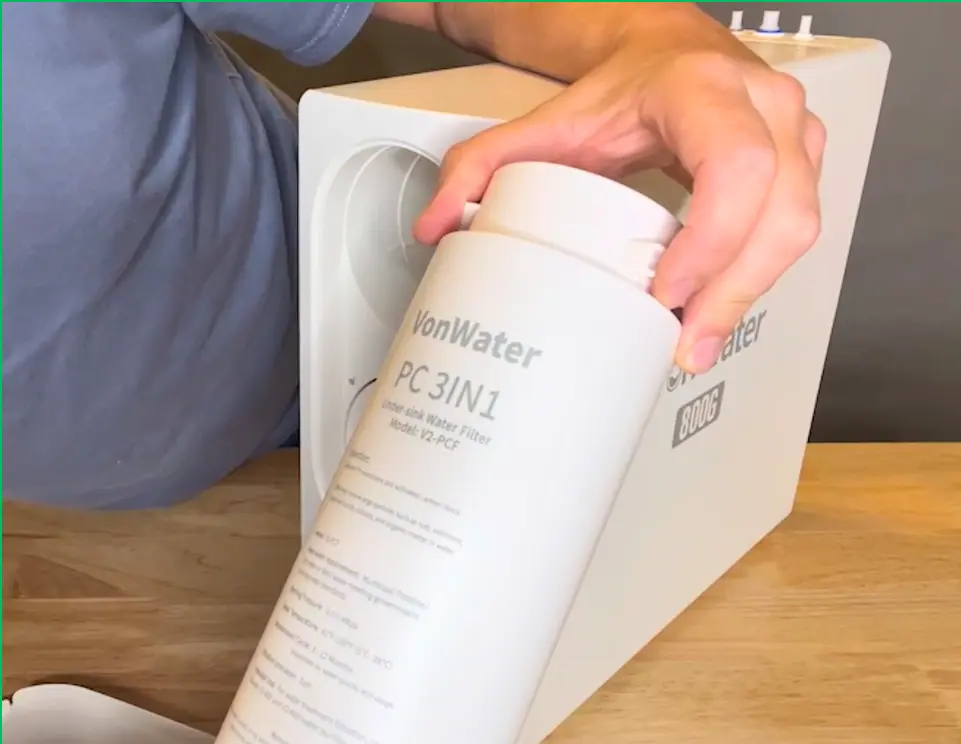
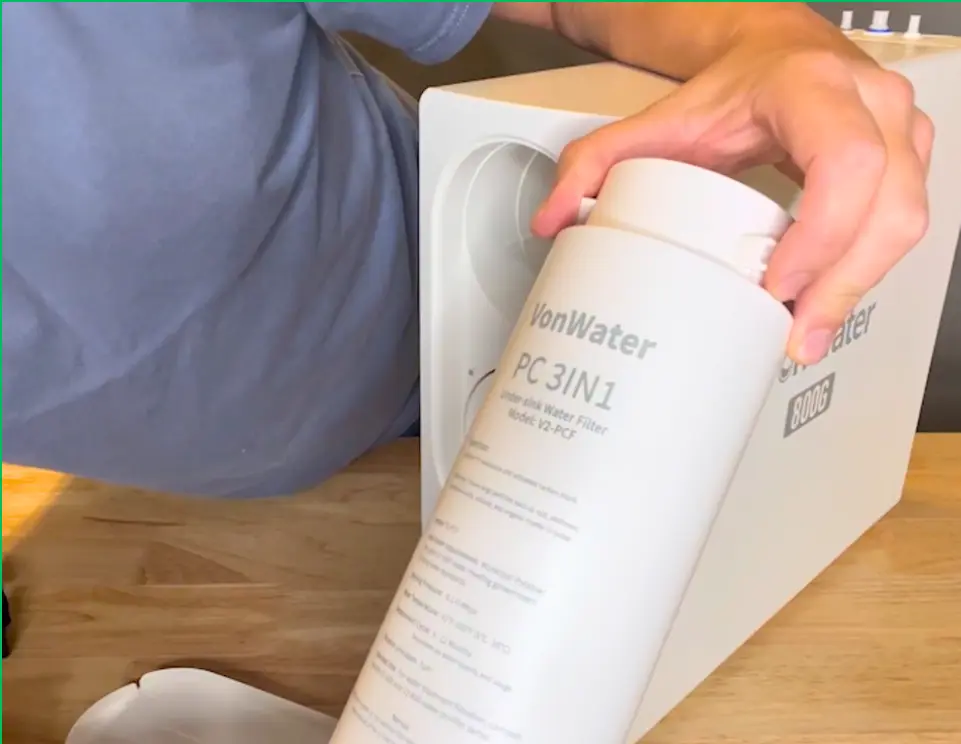 The PC3IN1 cartridge is accessible behind the removable front cover.
Front access made cartridge handling straightforward. Our notes recorded roughly 30 seconds for the physical swap, with trace drops in the front tray. The complete maintenance process takes longer because it includes preparation, reset, flushing, and checking connections.
The manual specifies counterclockwise removal, clockwise installation, selecting the relevant filter, a five-second Select-button reset, and a 30-minute post-replacement flush.
Replacement prices checked on October 20, 2026 were $39 for the PPC cartridge and $79.99 for the 800G RO cartridge. Listed intervals are 6–12 months for PPC and 12–24 months for RO, depending on use and water quality.
Those intervals imply approximately $79–$158 per year in annualized cartridge costs at the checked prices. Water, electricity, shipping, and tax are additional. Our tests did not verify those service-life intervals.
The manual lists a one-year limited warranty excluding filters, with an additional six months through registration. Keep the purchase record and confirm the applicable terms when buying.
PFAS Claims and Certification
VonWater advertises NSF/ANSI 372 compliance. This standard addresses lead content in product materials; it does not establish PFAS reduction or overall contaminant-removal performance.
We did not independently test PFAS, lead, arsenic, or fluoride reduction. Neither our TDS results nor the advertised membrane pore size establishes those outcomes.
If a particular contaminant is driving your purchase, check an exact-model certification listing or performance report covering that substance. The seven-stage description is not a substitute.
How it Compares
How the VonWater V2-800N Compares
VonWater V2-800N vs. V2-600N
VonWater lists the V2-600N at 1.58 L/min and the V2-800N at 2.1 L/min. At those rated flows, a liter would take approximately 38 and 29 seconds respectively, excluding startup.
That comparison is calculated from specifications; we did not test the models side by side. Choose the 800N for faster container filling, rather than assuming its larger capacity means stronger filtration.
VonWater V2-800N vs. a Tank-Based RO System
The V2-800N avoids a separate storage tank and produces water on demand. That arrangement helps when tank placement is the main installation obstacle.
It also brings pump noise and an electrical requirement. Compare complete installed space, actual dispensing behavior, cartridge costs, and contaminant-specific evidence before deciding. Tankless construction alone does not establish better water treatment.
Conclusion
Final Verdict: Who Should Buy It?
The VonWater V2-800N makes its strongest case for buyers who value a narrow installation and fast bottle filling. Our continuous-draw wastewater measurement also matched its advertised 2:1 ratio.
We are less comfortable recommending it primarily for strong TDS rejection: the recorded reduction was 70.4%, and first-glass readings increased after overnight inactivity. Buyers seeking verified treatment of a particular contaminant need evidence beyond this review.
For convenient dispensing, it has practical strengths. For filtration performance, our measured result warrants scrutiny before purchase.
Sources
Engr. Hm Jamal
Founder & Lead Technical EditorFounder of Wits Engineer, with a practical background in electrical and water systems. His product reviews focus on setup, performance, maintenance and the trade-offs that affect everyday ownership.